Pages

Showing posts with label Wednesday's Wages. Show all posts

Wednesday, May 4, 2011

When Easterners live in Western Territories

Fr. George Gallaro is a professor of canon law and ecumenism at the Byzantine Catholic Seminary of Ss. Cyril and Methodius, among many other distinguished positions he's held in these fields over the almost four decades he's been a priest, such as being a judicial vicar and a staff member for the Pontifical Council for Promoting Christian Unity. He holds a licentiate in ecumenical theology and a certificate in liturgical theology as well as a doctorate in Eastern canon law.

I asked Fr. George about the Italian Episcopal Conference's leaked decision to forbid married Romanian Catholic priests from serving their faithful in Italy. Below is part one of three in which he presents the issues that occur when easterners live in western territories.


Canonical Integration of Eastern Faithful in Latin Dioceses
Fr. George Gallaro

In compliance with the Church common law, every faithful acquires a domicile or quasi-domicile in a diocese or parish from the place where he/she resides. In order to understand the obligation of a Latin bishop towards these faithful present in his diocese, it is necessary to see when Eastern Catholics “enter” into a Latin diocese and are therefore subject to the jurisdiction of the local bishop.

The 1917 Latin Code of Canon Law (cc. 215-217) underlined the territorial aspect of the diocese, and the jurisdiction of its bishop extended on all faithful residing within its borders. As a consequence, the faithful subject to another personal jurisdiction had to be explicitly indicated, as free from the jurisdiction of the bishop “of the place,” who normally was a Latin.

A precise determination on Eastern faithful without their own Church Shepherd goes back to Pope Leo XIII - in the Apostolic Letter On the Eastern Churches, Orientalium Dignitas, November 30, 1894. In its directive part of the document, Leo XIII solved the issue of the faithful residing outside the territory of their own ritual patriarchate (or equivalent) and lacking their own clergy, by establishing the norm that these Eastern faithful were subject to the jurisdiction of the local Latin bishop. By the same apostolic L\letter Leo XIII extended the jurisdiction of the Greek Melkite Patriarch to all the territory of the Ottoman Empire (later on, all the other Patriarchates followed this norm).

In 1949 these directives were still in force, even though outdated, as it appeared more and more clearly that each jurisdiction was and is at the same time territorial and personal. These groups of Eastern faithful were ritually different but subject to the local Latin bishop. These norms which considered the Latin diocesan bishop as the only bishop “of the place” were out-of-date with the promulgation of the canons On Marriage in the Eastern Church, Craebrae Allatae (1950). This motu proprio in fact recognized the co-existence of more jurisdictions in the same territory. The canons clearly indicated who, in case of a plurality of bishops or pastors, is competent in single cases to assure the validity of marriages celebrated by Eastern faithful residing outside their own territory.

The norm relating to domicile or quasi-domicile on the part of Eastern faithful lacking their own ritual authority was extracted from the canons On Persons, Cleri Sanctitati (1957) - not yet promulgated. It became then unequivocally clear the link between the single Eastern faithful and the bishop and pastor endowed with the faculty to validly assist and bless their marriages, although they were of “different rite.”

In those territories where there was more than one ritual bishop, the local Latin bishop was not automatically in charge of the Eastern faithful residing in his territory. These faithful were subject to Latin jurisdiction only when explicitly designated by the Holy See or, in specific cases, by their patriarch.

Finally, the Second Vatican Council underlined the community aspect within a diocese. Indeed, Vatican II describes a diocese prescinding from its territorial limits: “a diocese/eparchy is a portion of the people of God that is entrusted to a bishop and gathered in the Holy Spirit through the Gospel and the Eucharist.”

The 1983 Latin Code (c. 372) also states that “a diocese is limited to a definite territory” so that it includes all the faithful living in the territory. But it adds that “where in the judgment of the supreme authority of the Church it seems advantageous after the conference of bishops concerned have been heard, particular churches distinguished by the rite of the faithful or some other similar reason can be erected in the same territory.”

The erection of an ecclesiastical province or region, even in the case of a patriarchal or major archiepiscopal Church (but “outside of their territory”) is in fact of exclusive competence of the Holy See. Such an erection is indicated by the decree on the Eastern Churches, Orientalium Ecclesiarum ( N. 4), as a provision to be adopted when it’s necessary. The norm is resumed by the decree On the Bishops Pastoral Office in the Church, Christus Dominus (N. 23, 3) which quotes the aforesaid paragraph of Orientalium Ecclesiarum, but only as a last resort. The Latin Code limits further this provision as it imposes on the supreme authority of the Church ( = the Roman Pontiff or an Ecumenical Council) to hear the Episcopal Conference concerned.

The pre-Vatican II Eastern norms – On Marriage (1949) and On Persons (1957) - is now incorporated, with due updating, in the Code of Canons of the Eastern Churches (1990). Can. 916 § 4: “If there is no pastor for the Christian faithful of a certain autonomous Church, the eparchial/diocesan bishop for those same faithful is to designate the pastor of another autonomous Church, who is to assume their care as their proper pastor.” § 5: “In places where not even an exarchy has been erected for the Christian faithful of a certain autonomous Church, the local hierarch of another autonomous Church, even the Latin Church, is to be considered as the proper hierarch of these faithful. If, however, there are several local hierarchs, that one whom the Holy See has designated is to be considered as their proper hierarch or, if it concern the Christian faithful of a certain patriarchal (or major archiepiscopal Church), the one whom the patriarch (or major archbishop) has designated with the assent of the Holy See.”

I leave to others the answer to the question that could be raised by the term “as their proper pastor” (tamquam parochus proprius) used in the canon, and other canonical directives mentioned in cc. 148 & 193 of the Eastern Code. It could be in fact raised the doubt if the designated bishop and parish priest are truly (de iure) the bishop and parish priest of those faithful, or only temporary carers or simple substitutes.

Looking at the issue from the faithful’s side, one could ask if they are full-fledged members of those dioceses and parishes of acceptance, and have thus double membership, their own autonomous Church and the diocese or parish of their domicile, or if, as “entrusted” faithful, they are in a sense only “guests/visitors.”


Tune in tomorrow to read part 2 where Fr. George discusses the canons that come into play when easterners live in western territories...

Wednesday, April 20, 2011

Untouchable Converts

In India, the Hindu caste system is one of numerous sources of interreligious tension and persecution, especially as those from the lowest castes convert to Christianity. They often take their caste designation with them, being considered Dalit Christians, or converts from the Islamic or Hindu untouchables caste.

In 2008, these Christians in India were systemically targeted by Hindu fundamentalist mobs who blamed Christians for the murder of a Hindu leader. Police exonerated the Christian community, which has been in India since the earliest days of Christianity, but their houses were still burned, many brutally murdered, and thousands driven from their homes. Here's a newscast from the time:


Wednesday's Wages are a series of posts which highlight past and present struggles faced by Eastern and Oriental Catholics including the topics of bioethics and persecution. Do you know of a homily, lecture, interview or biography which you think should be featured here? Leave a comment to let me know.

Wednesday, March 30, 2011

Ukraine: A Forgotten Generation

Aid to the Church in Need, an international Catholic charity under the guidance of the Pope, made the below video to discuss the plight of Ukrainian children following the fall of Communism. It specifically addresses how the Communist Persecution affected the Ukrainian Greek-Catholic Church's ability to provide social and educational care to the poor.


Wednesday's Wages are a series of posts which highlight past and present struggles faced by Eastern and Oriental Catholics including the topics of bioethics and persecution. Do you know of a homily, lecture, interview or biography which you think should be featured here? Leave a comment to let me know.

Wednesday, March 16, 2011

History of Voluntary or Mandatory Clerical Celibacy

Below is a very small excerpt from a work by A. G. Bell III which covers the author's well-cited research on the history of celibacy and marriage among clergy in the Catholic Church. The link has the full article.

Ordination of Married Man in the Eastern Church
In the previous year, 1971, the Holy Synod of the Greek-Melkite Catholic Church at its annual meeting in Ain-Traz, Lebanon, attempted to clarify the relationship between the priesthood and celibacy and marriage. The Synod stated in point 9 of its “Official Teaching”: “As regards the question concerning the connection between celibacy and the priesthood, the experience of our Church confirms, as we have already stated, that there is no intrinsic connection between celibacy and the priesthood; the two are distinct charisms. Celibacy, together with the priesthood, is a special way of bearing witness in the Church.” The Synod took great pains in its “Official Teaching” to show the advantages of both married and celibate priests and the need for both in today's Melkite Church.
In Europe today, the Greek Catholic Church in Slovakia has been ordaining married men to the priesthood as has been its custom since its origins. This discipline was never voided, even though there was at times a strong tendency to latinization in that region when some Latin hierarchs or strongly latinized Byzantines wanted to impose celibacy in the Greek Catholic Church. 
The Ukrainian Greek Catholic Church on the territory of Ukraine ordains to the priesthood candidates who are married, and has never stopped, even during the underground period from 1946 to 1989.  There had been an attempt to change the traditional discipline for a short period after World War I in Galicia (Western Ukraine). The three bishops there-Metropolitan Andrew Sheptytsky of Lviv, Bishop Josaphat Kotsylovski of Peremyshl and Bishop Gregory Khomyshyn of Stanislaviv-decided to admit to seminaries only candidates who were willing to accept ordination as celibates. However, due to a shortage of suitable candidates, Metropolitan Andrew soon reversed his decision and began to accept candidates who would marry before ordination. The eparchies of Peremyshl and Stanislaviv also could not attract a sufficient number of celibate seminarians. Later, Metropolitan Andrew's successor, Metropolitan Joseph Slipy preferred ordaining celibate candidates. Towards the end of World War II some of the older, married Galician priests fled with their families from the Communists and went to Western Europe and eventually to North America. 

Wednesday, March 9, 2011

The Minnesota Blizzard Makes His Way to Modern Italy

Recalling that it was for only 30 silver shekels that Judas betrayed the Lord 

Romanian Catholic priests who were legitimately married before their valid ordinations may not serve their own faithful in Italy, according to a leaked document from the Italian Catholic Episcopal Conference:
Cardinal Angelo Bagnasco
Archbishop of Genoa, Italy
and president of the
Italian Episcopal Conference
(The Romanian Catholic Church follows the Byzantine liturgical rite and retains many customs — such as a married priesthood — similar to Eastern Orthodoxy, from which it broke away in 1698 when it entered union with Rome. It is estimated there are more than half a million Romanian Catholics in Italy.) 
The letter from the Bishops’ Conference cited the importance of “protecting ecclesiastical celibacy” and the need to “prevent confusion among the faithful.” At issue is the concept that the free exercise of the right of Eastern Catholic Churches to ordain married priests is limited to their “canonical territory” or traditional homelands. Outside of their traditional territories, this right is seen as subject to regulation by the Pope.  
Click here to see the the full article on the website of St. Elias the Prophet Ukrainian Greek-Catholic Church of Brampton, Ontario, Canada.

Wednesday's Wages are a series of posts which highlight past and present struggles faced by Eastern and Oriental Catholics including the topics of bioethics and persecution. Do you know of a homily, lecture, interview or biography which you think should be featured here? Leave a comment to let me know.

Wednesday, February 16, 2011

Greek Catholics in the USSR

Recalling that it was for only 30 silver shekels that Judas betrayed the Lord

A brief excerpt from Simkovich.org's page on Carpatho-Russian Religion:
Greek Catholic Bishop
Theodore Romzha -
Killed by the NKVD
(KGB) in 1947 

"In 1946, all the Greek Catholic bishops and the majority of priests were sent to concentration camps in Siberia." -Anna, niece of Aleksander Simkovich

Conversely, it was Greek Catholics of the Carpathians who suffered in the 1940s. The Soviet government annulled the Union of Uzhgorod in 1946, and the Greek Catholic Church was liquidated. Priests who refused to convert to the Russian Orthodox Church were sent to the Siberian and Arctic labor camps, where most died. Others were simply murdered in their home villages. To add salt to the wound, in 1971 the Russian Orthodox Synod of Zagorsk, U.S.S.R. indirectly justified this violence by officially ratifying the annulment.

Wednesday's Wages are a series of posts which highlight past and present struggles faced by Eastern and Oriental Catholics including the topics of bioethics and persecution. Do you know of a homily, lecture, interview or biography which you think should be featured here? Leave a comment to let me know.

Wednesday, February 9, 2011

Armenian Genocide

Recalling that it was for only 30 silver shekels that Judas betrayed the Lord 

An excerpt from
"Armenian History"
by Levon Zekiyan

Persians ruled Eastern Armenia until 1828, when it was annexed by Russia. However, it was the Ottoman Turks who governed most of the Armenian land and population (Western Armenia). During the 19th century, Armenians under Turkish rule suffered from discrimination, heavy taxation and armed attacks.

As Christians, Armenians lacked legal recourse for injustices. They were taxed beyond their means, forbidden to bear arms in a country where murdering a non-Muslim often went unpunished, and were without the right to testify in court on their own behalf. During the late l9th century, the increasingly reactionary politics of the declining Ottoman Empire and the awakening of the Armenians culminated in a series of Turkish massacres throughout the Armenian provinces in 1894-96. Any illusion the Armenians had cherished to the effect that the acquisition of power in 1908 by the Young Turks might bring better days was soon dispelled. For in the spring of 1909, yet another orgy of bloodshed took place in Adana, where 30,000 Armenians lost their lives after a desperate resistance. World War I offered a good opportunity for Turks to "solve the issue." In 1915, a secret military directive ordered the arrest and prompt execution of Armenian community leaders.

Armenian males serving in the Ottoman army were separated from the rest and slaughtered. The Istanbul government decided to deport the entire Armenian population. Armenians in towns and villages were marched into deserts of Syria, Mesopotamia and Arabia. During the "relocation" many were flogged to death, bayoneted, buried alive in pits, drowned in rivers, beheaded, raped or abducted into harems. Many simply expired from heat exhaustion and starvation. 1.5 million people perished in this first genocide of the 20th century. Another wave of massacres occurred in Baku (1918), Shushi (1920) and elsewhere.

The defeat of the Ottoman Turks in World War I and the disintegration of the Russian Empire gave the Armenians a chance to declare their independence. On May 28, 1918, the independent Republic of Armenia was established, after the Armenians forced the Turkish troops to withdraw in the battles of Sardarapat, Karakilisse and Bashabaran. Overwhelming difficulties confronted the infant republic, but amid these conditions the Armenians devoted all their energies to the pressing task of reconstructing their country. But due to pressure exerted simultaneously by the Turks and Communists, the republic collapsed in 1920. Finally, the Soviet Red Army moved into the territory (Eastern Armenia) and on November 29, 1920, declared it a Soviet republic. Armenia was made part of the Transcaucasian Soviet Federal Socialist Republic in 1922, and in 1936, it became one of the Soviet Union's constituent republics.

The tumultuous changes occurring throughout the Soviet Union beginning in the 1980's inevitably had repercussions in Armenia. In 1988, a movement of support began in Armenia for the constitutional struggle of Nagorno Karabagh (Artsakh) Armenians to exercise their right to self-determination. (This predominantly Armenian populated autonomous region had been placed under the jurisdiction of Azerbaijan by an arbitrary decision of Stalin in 1923.)

That same year, in 1988, Armenia was rocked by severe earthquakes that killed thousands, and supplies from both the Soviet Union and the West were blocked by the Azerbaijani Government fighting the Armenians in Nagorno Karabagh. Both of these issues have dominated Armenia's political arena since the first democratic election held in Armenia during the Soviet era. In 1990, the Armenian National Movement won a majority of seats in the parliament and formed a government. On September 21, 1991, the Armenian people overwhelmingly voted in favor of independence in a national referendum, and an independent Armenia came into being.

Wednesday's Wages are a series of posts which highlight past and present struggles faced by Eastern and Oriental Catholics including the topics of bioethics and persecution. Do you know of a homily, lecture, interview or biography which you think should be featured here? Leave a comment to let me know.

Wednesday, February 2, 2011

The Minnesota Blizzard's Americanism

Recalling that it was for only 30 silver shekels that Judas betrayed the Lord 

A Roman Catholic archbishop who was nicknamed the "Minnesota Blizzard" was so convinced of the heresy of Americanism that it led him to drive what eventually became tens and possibly hundreds of thousands of Ruthenian Catholics out of the Catholic Church, leading to the new nickname of "The Father of American Orthodoxy" in reference to the Ruthenians who joined the Russian Orthodox Church in Archbishop Ireland's wake. Below is a short excerpt from Marvin Richard O'Connell's John Ireland and the American Catholic Church which covers some of the difficulties Greek-Catholic immigrants from Eastern Europe experienced upon moving to the United States in the 18-1900s. (It uses terminology that is considered offensive today but which was acceptable at the time.)
     Two weeks after writing the long report to Cardinal Gibbons about the Scandinavians, on December 19, 1889, the archbishop of St. Paul gave an interview in his office to Father Alexis Goergievich Toth, recently arrived in the United States from his birthplace and the scene of his early priestly ministry in the Austro-Hungarian Empire. Toth, a learned man of thirty-six, was a Uniate--that is, he belonged to one of the non-Latin rites in union with the Roman see but distinctive in their liturgical languages and ecclesiastical customs. A group of Ruthenian Uniates had established their own parish earlier in the year in Northeast Minneapolis--where a good many eastern European immigrants had settled--and had called Father Toth to be their pastor.
     The priest presented the archbishop his credentials, and, as Toth recalled it, Ireland's hands trembled as he read them. Then he looked up, and said abruptly in Latin: "Have you a wife?"
     "No," Toth answered in the same language.
     "But you had one?"
     "Yes, I am a widower."
      Ireland tossed the documents on the desk in front of him. "I have already written to Rome protesting against this kind of priest being sent to me!"
     "What kind of priest do you mean?"
     "Your kind."
     "I am a Catholic priest of the Greek rite," Toth protested. "I am a Uniate and was ordained by a regular Catholic bishop."
     "I do not consider that either you or this bishop of yours are Catholic; besides I do not need any Greek Catholic priests here; a Polish priest in Minneapolis is quite sufficient; the Greeks can also have him for their priest."
      This rude and testy reaction on Ireland's part was only the beginning of his vendetta against the Uniates. He immediately instructed the clergy of Northeast Minneapolis to have no association with Toth and, furthermore, to state publicly from their pulpits that not even the Ruthenian Catholics were permitted to approach the Uniate priest for the sacraments. Nor was the archbishop content to manifest his dislike within the limits of his own jurisdiction. In every national forum during the succeeding years he pressed for a general prohibition of Uniate activity, and he carried his case directly to Propaganda. Father Toth, meantime, was not one to be intimidated; he carried on his ministry in the face of Ireland's hostility until 1891, when he and 365 parishioners, refusing in effect to either be Americanized or Latinized, were formally received into the Russian Orthodox church. What started as a trickle in Minnesota soon swelled into a vast wave of schism all around the country, costing the Roman church, by conservative estimates, a quarter of a million communicants.
      Ireland's bias against the Uniates was by no means unique; his episcopal colleagues, Americanist and anti-Americanist alike, shared it, or at least condoned it and thereby participated in causing the massive exodus. Their conduct, if tragically shortsighted, was perfectly predictable. One principal reason for it can be seen in the very first part of the exchange between Ireland and Toth: celibacy for the parochial clergy was not a requirement in the Eastern tradition, whether Uniate or Orthodox. Some bishops feared--though Ireland himself did not stress this point--that their Latin-rite priests would demand wives if the married Uniates established parishes nearby. For Ireland, however, the problem was not so much one of sexual expression as of status and and conformity. In the United States a Catholic priest was, in the popular mind, defined as an unmarried man, and indeed enjoyed a certain position within his community as a result. Would it do to try to explain to the average Catholic parishioner that Father Toth was as much a priest as, say, Monsignor Ravoux? But of course he was, as the Catholic church had taught consistently for unnumbered centuries, and Ireland knew it. His attitude therefore is hard to forgive, but not hard to explain. And even leaving aside the celibacy issue, his obsession with the process of Americanization would have led him to strike hard at the Uniates, who were notoriously attached to their Old-World customs. Bad enough the Germans, who at least worshiped in the Latin tongue and maintained an unmarried clergy like other Catholics.
      Finally, the conflict boiled down, as did so many conflicts in Ireland's career, to the issue of governance. Toth's credentials came from his bishop back in Slovakia. They stated clearly that Toth and those like him were subject to the local Latin ordinary, until such time as a Uniate jurisdiction were established in the United States. This was a perfectly reasonable and canonically acceptable position to take. But Ireland and the rest of the hierarchy stubbornly resisted any such intrusion into their authority. Propaganda, so often annoyed at the American bishops' claims to independence of Rome, supinely surrendered to their demands vis-à-vis the Uniates, and so shared responsibility for the catastrophe that followed. When on one occasion Ireland wrote Simeoni to thank him for his support against the "Greeks," he put it succinctly the principle of policy that meant more to him than any other: "The difficulties encountered by the Church in America due to diverse populations coming to our shores are immense. The only remedy, I am convinced, is to strengthen the authority of the bishops [les bras episcopals]. It is the only way to bind the different elements together and prevent chaos and schism." These words have a hollow sound in light of events going on before Ireland's eyes.
      If Ireland's advocacy of the blacks displayed him at his best, his belligerence toward the Uniates showed him at his bull-headed worst. Meanwhile, the American dream still awaited fulfillment for all that multitude of diverse peoples who had settled the new land, but Ireland never doubted that his own mixture of religion and patriotism could bring that happy day ever closer.
Wednesday's Wages are a series of posts which highlight past and present struggles faced by Eastern and Oriental Catholics including the topics of bioethics and persecution. Do you know of a homily, lecture, interview or biography which you think should be featured here? Leave a comment to let me know.

Wednesday, January 19, 2011

Ukrainian Holodomor

Wednesday's Wages 
Recalling that it was for only 30 silver shekels that Judas betrayed the Lord 

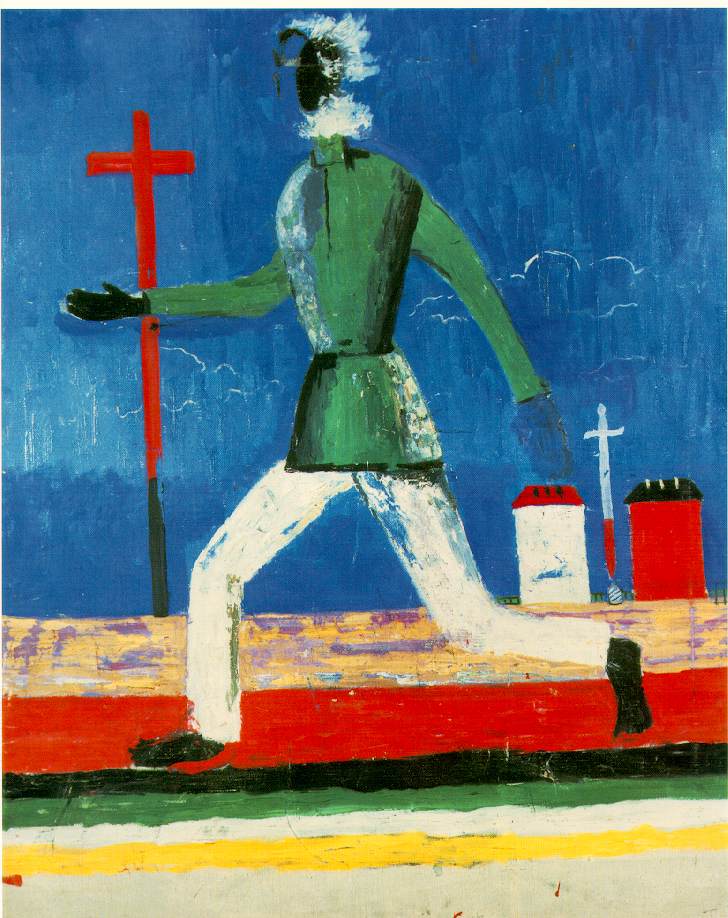
Running Man -
A Peasant Between Cross and Sword
Kasimir Malevich
~1932-34
There is great debate over the particulars of the Holodomor (Ukrainian: Ð“олодомор). Was it an intentional artificial famine created by Stalin in order to force Communist collectivism on independent Ukraine? The unintentional result of the Bolsheviks' poor policy mixed with a poor harvest? Were Ukrainians specifically targeted for death or just coincidentally among the hardest hit? Just how many millions died? Did it even occur?

The Ukrainian Greek-Catholic Church cannot be understood without understanding the history of oppression that Christian Ukraine has endured. One haunting piece of that puzzle that today's Ukrainian Greek-Catholics might directly recall is the Holodomor, though there aren't many who survived it.

In Ukrainian, the word holod means "hunger", and mor means "plague". The expression moryty holodom means "to inflict death by hunger." This is the story of how atheistic Communism achieved that in 1930s Ukraine:


It looks like a YouTube playlist bug is not allowing part 1 to show below.
It is therefore posted above as a workaround while the rest of the video is below.

Wednesday, January 12, 2011

Maafa 21: Genocide in the United States

Wednesday's Wages 
Recalling that it was for only 30 silver shekels that Judas betrayed the Lord 

Many Eastern and Oriental Catholics in the United States are direct targets of the American eugenics movement which seeks to eliminate poverty by eliminating the poor and desires to create a master race of healthy, attractive, fair-skinned, educated, wealthy individuals of northern European descent. They taught Hitler a large part of his eugenics theories and practices and they remain active in the United States today. This explains their why and how.

At that time, they did shift over to what they called "the quality of life." It was a philosophy unquestionably used to target the poor simply because what the quality of life at its core meaning was that poor people really didn't have a reason to live. Only the white--those with status--had any chance of a "meaningful" or "purposeful" life. The solution for the poor now was not to eliminate the circumstances that would cause poverty. Their solution now was to eliminate the poor--eliminate the impoverished--and just wipe them off the face of the earth. -Clenard Childress (Northeast Director of Life Education and Resource Network) 
Wednesday's Wages are a series of posts which highlight past and present struggles faced by Eastern and Oriental Catholics including the topics of bioethics and persecution. Do you know of a homily, lecture, interview or biography which you think should be featured here? Leave a comment to let me know.  

Monday, January 3, 2011

Current Events - The Middle East

Listen to an interview on the situation in the Middle East by Maronite Msgr. Sharbel Maroun on Ave Maria Radio

If you're in the Minneapolis, MN area, check out his parish!
Saint Maron Catholic Church
602 University Ave. NE
Minneapolis, MN. 55413
And if you aren't, check them out online.

Saturday, January 1, 2011

Coptic Catholic Christmas

Coptic church bombing in Egypt is latest assault on Mideast Christians


“As it happens with wine inside a barrel which, when the vineyard blooms in the field, senses it and the wine itself blossoms together with it, so it is with the souls of sinners. They receive some relief from the Bloodless Sacrifice offered for them and from charity. So, when we offer Divine Liturgies and charitable deeds in the name of those who have departed, their souls rejoice if they were righteous and receive some relief if they were wicked." -Anba Athanasius the Apostolic (c. 295-373)

Your Word From The Wise is a Christmas letter from Anba Antonios Naguib - December 25, 2010:

In The Name of the Father and of the Son and of the Holy Spirit, One God Amen

From Anba Antonios Naguib

With the Grace of God,
The Patriarch of the Coptic Catholics and Cardinal of the Catholic Church

To Our Brothers the Bishops, and our sons the Hogominos and Priests, the Monks, Nuns, and Deacons and to all the Coptic Catholic Church at the Home Land and Abroad.

Glory to God in the highest; and on earth peace to men of good will (Luke 2:14)

The birth of Christ is the birth of peace and reconciliation.

The Christmas brings true peace to humanity and a living incarnation of God’s love to man. The night of Christmas announced the message of peace in the song of angles that surrounded the Child of the manger. It is still echoing everywhere and in every human conscious “Glory to God in the highest; and on earth peace to men of good will (Luke 2:14)

The unity with God is the source of Peace:

The old testament of the Bible tells us about the creation of man in a simple magnificent way. The creation was out of God’s tremendous love and His most high divine Will. God said ‘Let us make man in our image, after our likeness…. God created man in his image; in the divine image he created him….God blessed them” (Genesis 1:26-28) the Bible continues” God looked at everything he had made, and he found it very good” (Genesis 1:31).

God created man in a state of righteousness and purity. A wise and free creature that is qualified to share the eternal happiness. He entrusted life to him, empowered him over the land and made him his successor (Gen. 1:27, 29). Man lived in true peace in unity with the creator, since the honorable life and safety of man are only achieved in his unity with God, obedience to him and fidelity to His laws. Regretfully the man broke the law, disobeyed his creator and rebelled against him. Hence the great failure and human tragedy, the man felt stripped from grace, overwhelmed with fear and anxiety and deprived of peace.

The world today is hungry for peace and will not find it unless it returns and unite with God while filled with faith and hope. Adam and his posterity lost their peace by separating from the origin, the beginning and the end. Because God is the absolute love, he opened the door of hope to Adam and his off springs through a divine truthful promise, in which His love will be incarnated as a savior coming from eve’s posterity who will strike the head of the serpent (Gen. 3:15). He will reinstate the peace between heaven and earth. In him, the love, light and uncontained divinity of God will be united with His perfect human nature. His mission will be to bring man back to God, to the high status and to fulfill the true meaning behind his creation and life on earth. Christ, the divine Word, the peace of God and the light of the world, is born. As St Paul describes Him in his letter to the Philippians “Who, 3 though he was in the form of God, did not regard equality with God something to be grasped. 4 Rather, he emptied himself, taking the form of a slave, coming in human likeness; 5 and found human in appearance “(Phil 2:6-7).

The Peace of Christ is reconciliation with God

The message of Christ is declared in the song of the angels “Peace on Earth”. St Paul announces that Christ is our peace and that his Bible is the Bible of peace (Ephesians 3:14, 6:15). He announces and preaches peace, as Isaiah previously prophesized (Is 52:7). With the coming of Jesus, a new divine peace was born. It is the peace of reconciliation with God, based on following His commandments, and the belief of His presence in the depth of man’s conscious. He plants peace in the heart of every man. He is the one who said “Do not let your hearts be troubled. You have faith in God; have faith also in me” (Jn 14:1). And also said Peace I leave with you; my peace I give to you. Not as the world gives do I give it to you. Do not let your hearts be troubled or afraid.” (Jn 14:27) and in the blessings (the Sermon on the mountain) which is the law of the new covenant” Blessed are the peacemakers, for they will be called children of God “(Mt 5:9). The Divine peace makes us children of God and brothers in humanity.

The Peace of Christ is reconciliation with oneself:

The example and teachings of Christ, as revealed in the Holy Gospels, are invitations to build a pure conscious. The peace that Christ has called for depends on the inner peace of man, and emerges out of a heart that is pure and full of love. Christ has restored to man his value and dignity that he has lost, and still loses, due to his sin and disobedience. He always worked to fill the hearts with divine peace. For the sake of man, He was born and lived, He performed miracles and forgave sins. He promised to open the doors of the heavens to every one who lives faithfully and to every one who truly repents. He reconciled man with God and hence the reconciliation of man with himself. The man could accept himself because he accepts the will of God in him knowing that” all things work for good for those who love God”(Romans 8:28).

The Peace of Christ is reconciliation for all people in love and forgiveness:

The birth of Christ is a starting point for a fundamental change in the relations between people. With His example and sayings, Christ taught us that love is the foundation of the right dealing among people, because they are brothers. When he taught us how to pray He said” Your Father knows what you need before you ask him.” This is how you are to pray: Our Father in heaven, hallowed be your name” (Mt. 6:8-9). Here He confirmed the main principle, that we are all the children of God, we are brothers in humanity regardless of religion, ethnicity, color, knowledge or nationality. Christ came for all people, to provide peace in reconciliation with God, with themselves and with each other. Christ taught us that reconciliation among people requires forgiveness and abandonment of violence, as he said” You have heard that it was said, ‘An eye for an eye and a tooth for a tooth. but I say to you, offer no  resistance to one who is evil”” (Mt. 5:38-39). “love your enemies, do good to those who hate you, bless those who curse you, pray for those who mistreat you.” (Luke 6:27-28). Christ taught us the grace of forgiveness. Through redemption He cleansed us from our sins and opened the door of forgiveness to all sinners. He asked us to pray to the Father saying” forgive us our debts as we forgive our debtors’’ and said “But if you do not forgive others, neither will your Father forgive your transgressions”(Mt. 6:12 &15). Reconciliation through forgiveness is a divine gift, bestowed by Christ on whoever wants the Divine peace. With that, Christ eliminates the fear of man from his brother the man and institutes a Divine peace that includes all humans, a peace that was never known before to humanity., therefore St. Paul commands us saying ” Strive for peace with everyone” (Heb 12:14)

Peace of Christ mandates justice and help for the poor and the needy:

Peace will not be fulfilled unless justice prevails among people. On the World Day of Peace, Jan 1, 2002, the title of the address of His Holiness Pope John Paul II was” No Peace without Justice” the message went on saying” Justice is the foundation of true peace”. Among the requirements of Justice is that the poor must receive their fair share in help and care. Christ the king of peace taught us that the final days judgment will be weighed against our stand towards those whom He called “the least of His brethren” whatever you did for one of these least brothers of mine, you did for me…. what you did not do for one of these least ones, you did not do for me” (Mt. 25:40, 45)
Truly, the peace of Christ is a Divine gift; however, it is a continuous work and uninterrupted fight for the good and charity. Peace between people and through the world will not materialize without the participation of every one. whoever has a heart that is open to God and has an active will for the good, will give the fruits of the spirit out of which are” Love, Joy and Peace” (Gal 5:22)

Peace in the life of the Catholic Church:

The Catholic Church is concerned with the peace of individuals, societies and the world. She is giving a special attention to it. The synod of the Middle East’s Bishops was held in October 2010 in The Vatican and was attended by 350 members and presided by His Holiness Pope Benedict XVI. The Bishops studied the urgent issues that, currently, are faced by our societies. The most important of which is peace. They ascertained that peace is the fruit of love, justice, equality, respect for humans, and that every faithful has to work for and spread peace.
In their final recommendations, the Bishops, dedicated an article to the relation with Islam, in which they emphasized” The Christians and Moslems share the life and destiny in the Middle East. Together they build the societies, therefore it is important to strengthen the definition of citizenship, the dignity of the human being, the equal rights and duties and the religious freedom that includes the freedom of worship and freedom of conscious.
The Christians in the Middle East must persevere in the dialogue of fruitful living with the Moslems. They have to value and love them and reject any negative prejudices against them. They are encouraged to discover the values of each other’s faith. With that they show the world how the two religions can constructively agree and productively cooperate through rejecting all kinds of fundamentalism and violence in the name of religion.( No. 42) In the same respect, His Holiness Pope Benedict XVI announced that the subject of his encyclical for the World Day of Peace , Jan 1, 2011 will be” Religious freedom, the way for peace”.

Conclusion

In this blessed night, we pray in unity with His Holiness Pope Benedict XVI and all our brothers the Patriarchs and Bishops, pleading to the almighty God that he preserves the life of our beloved President Hosni Mubarak, all his honorable assistants, and to support and bless his huge endeavors for the progress and prosperity of our dear nation while defending the religious and social values. We pray also for those who are entrusted with all responsibilities in our nation on the political, popular and safety levels. We congratulate those who have been elected representatives of people. We hope that their goal will be to serve the country and its people so that they bring a new dawn for a promising future of love and peace. May the Lord God keep Egypt always in safety and prosperity, brotherly love and peace. May the Lord bestow peace and stability to the suffering countries in our region especially Palestine, Iraq, Lebanon and Sudan. May His Divine peace overwhelm the world so that all humanity become one family singing with Christmas Angels “Glory be to God in the highest and peace
on earth”

Anba Antonios Naguib
Patriarch of the Coptic Catholics and Cardinal of the Catholic Church
An article about Anba Antonios Naguib by the Roman Catholic diocese of Omaha, NE can be read here.
Related Posts Plugin for WordPress, Blogger...