Pages

Showing posts with label Byzantine. Show all posts

Tuesday, October 12, 2021

Some Support for Fasting

An older woman in a head scarf winks, smiles, and points toward the reader's right shoulder. A bowl of borscht and slices of bread float beside her. A light pink background with horizontal blue bars creates a stylized background.
You feel called to grow deeper in your relationship with God through the rhythms of the church but don't have the time and experience for gauging next steps? 

You were raised with a fasting culture that emphasized giving up and suffering? 

You fast from food without difficulty but never really learned the theological and spiritual components of fasting?

You do not have access to a strong, healthy church community and are looking for sustainable ways to develop your domestic church life?

You've been fasting for years but now have children, a spouse, relatives, medical conditions, budget or time constraints that require re-assessing what you're doing? 

You were raised fasting but never learned the hows and whys of menu planning or nutrition? 

You are in a position of teaching others about food or fasting?

You're bored or listless and want to re-commit yourself to a lived faith life?


If this describes you, I made a little thing to share!

Click here to download the PDF:

Traditional Slavic Fasting
on the 2021-22 Gregorian Calendar

๐Ÿ˜‡๐Ÿ™๐Ÿผ Please offer a prayer for my intentions when you use it.  ๐Ÿ‘๐Ÿฅฐ


Included in the PDF:

  • A one-page cheat sheet for major fasting dates in 2021-2022 for the Slavic tradition on the Gregorian calendar. Easy to hang in a pantry, cupboard, on a bulletin board, or on the fridge.
  • A quick overview of the aims of fasting and the typical structure of abstention.
  • Nutrition information for fasting (protein, iron, calcium, Vit B12 and Vit D, iodine, omega-3s, etc)
  • A sample week's menu with images. Foods from around the world that provide a well-rounded nutritional profile, ease of use, low cost, and family-friendliness are prioritized.
  • An extensive list of whole food ingredients.
  • St. John Cassian's Eight Deadly Dominoes on fighting the passions.
  • Quotes from the Fathers on fasting.
  • St. John Chrysostom's homily on fasting.
  • Fr. Milan Savich's explanation of the meaning and purpose of fasting in the Byzantine tradition.
  • FAQs on fasting.
  • Bonus meal plan ideas and a recipe.
This menu emphasized diversity to give you a lot of new ideas. If there's interest, an update will include a batch prep menu with ingredient lists to streamline shopping and cooking--let me know if you'd like to see that and how many people you'd want it to plan to feed. And add your own favorite prayer-fasting-alsmgiving advice for others who are looking to grow!

Sunday, January 27, 2019

Spiritual Reading in Minutes A Day

7 Spiritual classics between now and Pentecost--you can make it happen!

I’ve come up with a plan to read seven classic and liturgically thematic works before Pentecost (four of which are free online), broken down into prayerful accessible chunks you can start right now.

Much of the content is food for thought needing days to chew on it before returning to it so this schedule takes advantage of that by interweaving connected themes between books for focused spiritual growth. I thought I would share so others can join me! Download it here!
  • *Alexander Schmemann’s Great Lent: A Journey to Pascha 
  • **Alexander Schmemann’s Liturgical Explanation of Holy Week (free online)
  • Vassilios Papavassiliou’s Thirty Steps to Heaven: The Ladder of Divine Ascent
  • Vladimir Soloviev’s A Short Story of the Anti-Christ (free online)
  • The Way of a Pilgrim (free online)
  • Brother Lawrence’s Practice of the Presence of God (free online)
  • Catherine Doherty’s Sobornost: Experiencing Unity of Mind, Heart, and Soul
Those on the old paschalion just move the date forward one week this year. Daily reading reminders at Your Word From the Wise's FB page include both new and old calendar.

*All of the books are appropriate for any Christian. Schmemann covers Byzantine liturgical practice which is beneficial to understand and explore the universality of the faith no matter one's tradition. Those who are already familiar with his work and not living within a Byzantine framework might prefer a more western lenten book for these Schmemann days.

May I suggest instead of Great Lent that such a person read Station to Station: An Ignatian Journey through the Stations of the Cross by Gary Jansen (intro and part one divided between the first three Great Lent reading days and each station subsequently getting its own reading day) or read the lenten classic The Sadness of Christ by Sir Thomas More which is free online and works out to only about 4 pages of reading per assigned day to get through the entire parts 1-5.

**Instead of Schmemann's Liturgical Explanation of Holy Week, the reader might choose Jesus of Nazareth: Holy Week: From the Entrance Into Jerusalem to the Resurrection by Pope Benedict XVI or The Living Flame of Love by St. John of the Cross which is free online. The intro and prologue would be read Palm Sunday, Stanza 1 on Holy Monday, Stanza 2 on Holy Tuesday, Stanza 3 lines 1-46 on Holy Wednesday, Stanza 3 lines 47-67 on Holy Thursday, and Stanza 3 lines 68-85 on Great and Holy Friday, with Stanza 4 completing the work on Holy Saturday.

Lenten and Paschal Reading Plan 2019
Preparing for the Great Fast

Jan 27: The Thirty-Sixth Sunday after Pentecost
Epistle: 1 Tim 1:15-17   Gospel: Luke 18:35-43
28: Great Lent Introduction - Lent: Journey to Pascha
29: Great Lent Ch. 5 - Participation in Lenten Services and Appendix (9) - A Total Rediscovery
30: Thirty Steps to Heaven Intro and Step 1
Download your printable schedule here!
31: Great Lent Ch. 1 - The Desire (Zacchaeus)
February 1: Thirty Steps to Heaven Step 2
2

February 3: Zacchaeus Sunday
Epistle: 1 Tim 4:9-15   Gospel: Luke 19:1-10
4: Thirty Steps to Heaven Step 3
5: Great Lent Ch. 5 - “Taking It Seriously…” and A Lenten "Style of Life”
6: Thirty Steps to Heaven Step 4
7: Great Lent Ch. 1 - Humility (The Publican and the Pharisee)
8: Thirty Steps to Heaven Step 5
9

February 10: Publican and the Pharisee
Epistle: 2 Tim 3:10-15   Gospel: Luke 18:10-14
11: Thirty Steps to Heaven Step 6
12: Great Lent Ch. 2 - The Triodion and Ch. 5 – “But By Prayer and Fasting"
13: Thirty Steps to Heaven Step 7
14: Great Lent Ch. 1 - Return From Exile (Prodigal Son)
15: Thirty Steps to Heaven Step 8
16: Great Lent Ch. 4 - Saturdays of Lent and Sundays of Lent

February 17: Prodigal Son Returns
Epistle: 1 Cor 6:12-20   Gospel: Luke 15:11-32
18: Thirty Steps to Heaven Step 9
19: Great Lent Appendix (1) - An Urgent and Essential Question and Appendix (2) - “Religionless Religion”
20: Thirty Steps to Heaven Step 10
21: Great Lent Ch. 1 - The Last Judgment (Meat-Fare Sunday) and Great Lent Ch. 2 – The Holy Scriptures
22: Thirty Steps to Heaven Step 11
23

February 24: Last Judgment (Meatfare)
Epistle: 1 Cor 8:8-9:2   Gospel: Matthew 25:31-46
25: Thirty Steps to Heaven Step 12
26: Great Lent Appendix (6) - The Meaning of Communion and Appendix (7) - The Meaning of Preparation for Communion and Appendix (8) - Confession and Communion
27: Thirty Steps to Heaven Step 13
28: Great Lent Ch. 1 – Forgiveness (Cheese-fare Sunday)
March 1: Thirty Steps to Heaven Step 14
2

March 3: Adam and Eve Cast from Paradise (Cheesefare)
Reading: Rom 13:11-14:4     Gospel: Matthew 6:14-21
4: Thirty Steps to Heaven Step 15
5: Great Lent Ch. 2 – The Lenten Prayer of St. Ephrem
6: Thirty Steps to Heaven Step 16
7: Great Lent Ch. 4 - The Beginning: The Great Canon
8: Thirty Steps to Heaven Step 17
9

Lenten and Paschal Reading Plan 2019
Preparing for Pascha

Download your printable schedule here!
March 10: Sunday of Orthodoxy
Epistle: Heb 11:24-26, 32-12:2   Gospel: John 1:43-51
11: Thirty Steps to Heaven Step 18
12: Great Lent Ch. 3 - The Evening Communion and Great Lent Ch. 3 - The Order of Service
13: Thirty Steps to Heaven Step 19
14: Great Lent Appendix (3) - Why Sacraments? and Appendix (4) - The Norm and (5) - The Decay: Its Causes And Its Excuses
15: Thirty Steps to Heaven Step 20
16

March 17: Gregory Palamas
Reading: Hebrews 1:10-2:3   Gospel: Mark 2:1-12
1:10-2:3 Gospel: Mark 2:1-12
18: Thirty Steps to Heaven Step 21
19: A Short Story of the Anti-Christ (first half)
20: Thirty Steps to Heaven Step 22
21: Great Lent Ch. 4 - Mid-Lent: The Holy Cross
22: Thirty Steps to Heaven Step 23
23

March 24: Veneration of the Holy Cross
Epistle: Hebrews 4:14-5:6   Gospel: Mark 8:34-9:1
25: Thirty Steps to Heaven Step 24
26: A Short Story of the Anti-Christ (second half)
27: Thirty Steps to Heaven Step 25
28: The Way of a Pilgrim 1
29: Thirty Steps to Heaven Step 26
30

March 31: John of the Ladder
Epistle: Hebrews 6:13-20   Gospel: Mark 9:17-31
April 1: Thirty Steps to Heaven Step 27
2: The Way of a Pilgrim 2 (first half)
3: The Way of a Pilgrim 2 (second half)
4: The Way of a Pilgrim 3
5: Thirty Steps to Heaven Step 28
6

April 7: Mary of Egypt
Epistle: Heb 9:11-14 and Heb 2:11-18   Gospel: Mark 10:32-45 and Luke 1:24-38
8: The Way of a Pilgrim 4 (first half)
9: The Way of a Pilgrim 4 (second half)
10: Thirty Steps to Heaven Step 29
11: Great Lent Ch. 4 - On The Way to Bethany and Jerusalem
12: Liturgical Explanation of Holy Week - Beginning of the Cross: Lazarus Saturday
13

April: 14: Entry of Our Lord into Jerusalem
Epistle: Philippians 4:4-9   Gospel: John 12:1-18
Liturgical Explanation of Holy Week - Palm Sunday
15: Liturgical Explanation of Holy Week - The End and On Monday
16: Liturgical Explanation of Holy Week - The Ultimate Passage and On Tuesday
17: Liturgical Explanation of Holy Week - On Wednesday
18: Liturgical Explanation of Holy Week - Holy Thursday
19: Liturgical Explanation of Holy Week - Great and Holy Friday
20: Liturgical Explanation of Holy Week - Great and Holy Saturday

April 21: Pascha
Epistle: Acts 1:1-8   Gospel: John 1:1-17
Paschal Homily of St John Chrysostom
22: Liturgical Explanation of Holy Week - Holy Pascha
23: Liturgical Explanation of Holy Week - Pentecost and Pascha
24: Practice of the Presence of God - Intro and Preface
25: Practice of the Presence of God - First Conversation
26: Practice of the Presence of God - Second Conversation
27

Lenten and Paschal Reading Plan 2019
Preparing for Pentecost

Download your printable schedule here!
28: Thomas Sunday
Epistle: Acts 5:12-20   Gospel: John 20:19-31
29: Practice of the Presence of God - Third Conversation
30: Practice of the Presence of God - Fourth Conversation
May 1: Practice of the Presence of God - First Letter
2: Practice of the Presence of God - Second Letter
3: Practice of the Presence of God - Third Letter
4

May 5: Myrrh-bearing Women
Epistle: Acts 6:1-7   Gospel: Mark 15:43-16:8
6: Practice of the Presence of God - Fourth Letter
7: Practice of the Presence of God - Fifth Letter
8: Practice of the Presence of God - Sixth Letter
9: Practice of the Presence of God - Seventh Letter
10: Practice of the Presence of God - Eighth Letter
11

May 12: Paralytic
Epistle: Acts 9:32-42   Gospel: John 5:1-15
13: Practice of the Presence of God - Ninth Letter
14: Practice of the Presence of God - Tenth Letter
15: Practice of the Presence of God - Eleventh Letter
16: Practice of the Presence of God - Twelfth Letter
17: Practice of the Presence of God - Thirteenth Letter
18

May 19: Samaritan Woman
Epistle: Acts 11:19-26, 29-30   Gospel: John 4:5-42
20: Practice of the Presence of God - Fourteenth Letter
21: Practice of the Presence of God - Fifteenth Letter
22: Sobornost - A Strange New World and Experienced at Pentecost
23: Sobornost - One in Mind and Heart and An Exchange of Hearts
24: Sobornost - The Fiat of a Jewish Maiden
25

May 26: Man Born Blind
Epistle: Acts 16:16-34   Gospel: John 9:1-38
27: Sobornost - Trinity: Fire, Flame, Motion
28: Sobornost - A New Creation
29: Sobornost - An Inner Pilgrimage
30: Sobornost - Becoming a Contemplative
31: Sobornost - Forging a Chain of Hearts
June 1

June 2: Fathers of the First Nicaean Council
Epistle: Acts 20:16-18a,28-36   Gospel: John 17:1-13
3: Sobornost - Unity in Eucharist
4: Sobornost - Service in Christ
5: Sobornost - The Little Mandate
6: Sobornost - Obstacles to Sobornost
7: Sobornost - We Have a Father
8

June 9: Pentecost
Epistle: Acts 2:1-11 Gospel: John 7:37-52; 8:12

Friday, August 31, 2018

15 Ways We Can Protect Against Abuse Right Now

A few of us ladies wanted to *do something* about the sexual abuse scandals and we wanted to make sure what was done included the needs and desires of Byzantines as well... so we went ahead and made the petition ourselves!

We included only issues all can agree on in the hopes of getting a huge number of signers. 

Facebook gave us a $30 boost credit but then they rejected our ad for being "political or of national importance." Go figure.

We need you to sign and share! Please note signees may choose to hide their names from view. It does not show their name to me or the public. Please let your priest and religious friends know that!

Add your voice by signing at The Petition Site: 15 Ways We Can Protect Against Abuse Right Now


FYI: It's a non-partisan platform. They don't rent/sell/loan your info. They know how to keep all your content safe and legal. All while being free. That means the small annoyance of having to click an almost invisible "more" text button in the lower right to reveal the full content was a worthwhile trade-off. Just in case you have any difficulties seeing it all, the full text of the petition is posted below.

Please click through and sign!


In response to deplorable revelations in the ongoing sexual abuse scandals within the Catholic Church, we, concerned laypeople, seminarians and aspirants, religious, clergy, and people of good will recommend these 15 points of immediate change to the Charter for the Protection of Children and Young People.

These revisions to the Church's Safe Environment protocols are a first and immediate step toward addressing some of the more nuanced points that recent scandals have highlighted as problematic in the Charter's current state.

While additional and difficult work will be required in reconciliation and repentance, all people of good will can agree on the immediate and necessary implementation of these 15 actions.

As such, we call on the hierarchy to immediately make these amendments in the Church's policies and practice as we work to bring mercy and justice to all affected by abuses within the Catholic Church:
  1. AUDIT: An impartial external audit will be conducted in order to identify the areas and mechanisms of corruption, along with avenues for rehabilitation and prevention, in order to align the Church's institutional culture and practices with Catholic doctrine, morality, and its members' state of life.
  2. VULNERABLE ADULTS: In addition to protecting children and the elderly, the definition of vulnerable adult will be expanded to include seminarians and religious aspirants; employees and subordinates; those being threatened or coerced; those with a large mental or developmental disparity by age or by ability; those who were previously victims or trauma, neglect, or abuse which made them susceptible to grooming or other forms of coersion; those for whom a large disparity of wealth, access, or resources presents a situation of intimidation and coercion; victims of human trafficking; those who are unfamiliar with the culture or its norms and safeguards due to immigration or language barriers; and when the accused has a relationship of spiritual authority over the victim.
  3. SPIRITUAL AUTHORITY: We will recognize that clergy and religious have a relationship of spiritual authority over all who know them to be clergy or religious and they are, therefore, representatives of the Church in all such relationships.
  4. ALL ADULTS ARE EQUAL: All adults (and those functioning in adult roles such as teens providing independent supervision of children), from volunteers through hierarchs, will follow the same Safe Environment protocols while acting in the name of the church.
  5. LAW ENFORCEMENT FIRST: A report of sexual or other criminal abuse is to be properly reported to the civil authorities with notification given to the church.
  6. GOOD FAITH REPORTING: Any report of sexual abuse or other criminal activity that is only made to the church will be reported to law enforcement by the church herself.
  7. TRANSPARENCY: All reports of sexual or financial abuse--including the expanded definitions of vulnerable adults above--which were not previously turned over to law enforcement will now be voluntarily turned over to law enforcement by the church.
  8. VICTIMS' ADVOCATE: A victims' advocate will be available to all reporters of violence and abuse to compassionately act in the interest of the alleged victim as he or she navigates the reporting, testifying, and healing processes. If allegations or findings of abuse are made public, the advocate will arrange for the spiritual and psychological support of the scandalized. The advocate must have appropriate training, qualifications, and resources to act in this role.
  9. CLERGY FAMILIES: Advice on provisions specific to married clergy and their families will be sought from affected stakeholders in order to allow clergy families the highest degree of protection, flexibility, and freedom from onerous burdens.
  10. DUE PROCESS: A measurable system of due process will be instituted in order to protect the good name and reputation of the workers who labor ethically in the vineyard of the Lord, that they not have cause to fear the repercussions of any false accusations.
  11. THIRD PARTY REPORTING: A report of sexual, financial, or criminal misconduct by a third party will be able to initiate an investigation (ie someone who learned of the allegations indirectly, such as the catechist of an informant).
  12. WE'LL ACT EVEN IF YOU DON'T: A church investigation along with findings and recommended actions will be done to its fullest extent following a report of mismanagement or abuse even when the alleged victim, accused, law enforcement and/or other key players do not cooperate with the church's investigation.
  13. VIOLATION OF INNOCENCE: The classroom training given to minors and vulnerable adults through the Safe Environment program will be updated to catechize them in their Christian identity, biology, vocation, and community in a way that helps them to have healthy relationships, boundaries, and a Christian worldview without violating their innocence by introducing inappropriate or fearful thoughts, images, or abuses.
  14. IMMORALITY: All clergy and religious who have a pattern of immoral behavior concerning chastity appropriate to their state in life, financial mismanagement, or criminality will be permanently removed from all teaching, preaching, and public ministry.
  15. SANCTIONS: The bishop will publicly release the names of those who by internal investigation or legal proceeding are found to have likely or positively abused others, and/or when sanctions are placed on a person's preaching, teaching, confessing, traveling, or other aspects of public life.


    Friday, May 6, 2011

    When Easterners live in Western Territories - Part 3 of 3

    Here is Part 3 of 3 from Fr. George Gallaro's discussion of canonical integration of Eastern faithful in Latin dioceses.

    Obligations of Latin Diocesan Bishops
    Let us examine now can. 383 § 2 of the Latin Code which regards the obligations of the diocesan bishops in assisting the Eastern faithful residing in their dioceses.

    Through priests ... of the same rite
    The first and simplest way for the pastoral care of the Eastern faithful in the safeguard of their rite is the ministerial service of priests of the same rite as the Christian faithful. As an alternative the bishop can even entrust the pastoral care of these faithful to priests of other ecclesiastical jurisdiction and ritual tradition, provided they are qualified to give such a spiritual assistance. The norms for the pastoral care of the people on the move – Erga migrantes (May 3, 2004) – could also be helpful in this matter.

    … Or through parishes of the same rite
    A further step along with the designation of priests of the same rite as the faithful is the erection of parishes of that same rite. As mentioned, the Eastern faithful acquire with their domicile or quasi-domicile not only their own hierarch but also their parish priest.

    If an eparchy covers a vast territory, it is difficult to establish several parishes. They will necessarily be established in places with greater concentrations of faithful. And in this case the priests will have difficulty in maintaining regular contacts with their faithful. The Eastern Code, in order to assure the pastoral care for all faithful, suggests to the eparchial bishop to designate the pastor of another autonomous Church, with the consent of the eparchial bishop of the pastor to be designated. Should the proper bishop of some faithful be lacking and already been duly entrusted to a bishop of another autonomous Church, even a Latin bishop, he is to take care of these Eastern faithful through priests of their same rite.

    ... Or through an episcopal vicar
    This is the third proposal by the Latin Code which corresponds to the decree Christus Dominus (23,3): “… or through an episcopal vicar endowed with the necessary faculties.” If the groups of Eastern faithful of one or more autonomous Churches residing in a Latin diocese are numerous and well organized, the diocesan bishop is urged to appoint an episcopal vicar for them. Thus the diocesan bishop, through the person of his episcopal vicar, will guide the various groups, study their problems, care for their spiritual needs and coordinate their pastoral activity.

    Rights and Duties of a Patriarch and a Major Archbishop

    In compliance with the Eastern Code the authority/jurisdiction of a Catholic Patriarch and Major Archbishop is limited to the territory of the respective patriarchal or major archiepiscopal Church. There are however cases in which they can intervene outside their territory for the pastoral good of the faithful of their autonomous Church, including those who live in Latin dioceses.

    As for the nomination of a priest, a pastor or an episcopal vicar
    In these cases, as mentioned above, one deals with internal norms of the receiving diocese, and therefore the choice of the candidates is exclusively up to the local bishop (CIC cc. 477, 515, 523). A previous consultation with the hierarchy of the autonomous Church of the faithful in question would be commendable, especially in dealing with a patriarchal or major archiepiscopal Church. It also would be highly desirable that the designation of more suitable candidates could come from the patriarch or major archbishop.

    The Eastern Code is more demanding in this matter. In fact, its can. 193 § 3 requires that the local diocesan bishop for the faithful of a patriarchal or major archiepiscopal Church acts in agreement with its respective superior authority. However, can. 193 regards only Eastern eparchial bishops. The Papal Commission for the review of the Eastern norms proposed in 1988 to include “also the Latin bishops,” but in 1990 the supreme legislator did not want to bind by this norm the Latin bishops. However, since the more frequent cases regard the Eastern faithful present in Latin dioceses, it could be said that said omission has made useless the content of the norm.

    Since one deals here with a norm of papal law, the patriarchs and major archbishops could equally demand the observance of this norm which gives them an important faculty/power. The Latin bishops, on the other hand, could make a stand against this presumed “intrusion” of other hierarchs in the internal affairs of their dioceses, since the norm in question is present only in the Eastern Code. Then what? It is desirable that the good common sense and ecclesial spirit of these hierarchs incite them to willingly cooperate for the well-being of the faithful, to quickly resolve eventual conflicts, and to avoid all opposing trends.

    Seeking Information on Eastern Faithful
    The Eastern Code foresees another right of the patriarch and major archbishop which could create conflicts with the Latin bishops. “It is the right and the obligation of the patriarch (and major archbishop) to seek appropriate information concerning the Christian faithful who reside outside the territorial boundaries of the Church over which he presides, even through a visitor sent by himself with the assent of the Holy See.” (c. 148).

    The patriarchs and major archbishops visiting their faithful are generally well received by the Latin bishops. But how would these Latin bishops react if the said patriarchs or major archbishops were to criticize the way in which the pastoral care is carried on in their dioceses? Once again, the Latin Code does not say much on the matter!

    Conclusion

    The Christian faithful of the Eastern Churches have the right and duty not only to preserve the traditions of their own Church and to worship God according to the their liturgical customs in their historical territories or in other regions of the world, but also, insofar as possible, when they live under the jurisdiction of bishops of a different autonomous Church.

    We have just considered the case of Latin bishops, and seen as they are invited to meet the pastoral care of the Eastern faithful through qualified clergy and convenient facilities in order to preserve their traditions. This is not only a right of the faithful but also a pastoral requirement since their separation from the original milieu could cause doctrinal and moral confusion.

    Vatican II and the Latin Code offer to the Catholic bishops some trusty guidelines, while the Eastern Code gives to the patriarchs and major archbishops the faculty to assess the state of their faithful in the so-called diaspora either personally or through appointed visitors. Also the Holy See, through the Congregation for the Eastern Churches, follows these faithful and, when necessary, proposes to the Roman Pontiff the practical norms to solve the various issues.

    The Christian faithful of the so-called diaspora are not neglected by their particular Church nor by the Universal Church. The successor of Peter, the Bishop of Rome, also continues to promote the progress of the faithful custody and diligent observance of all the Eastern Ritual Churches.

    Thursday, May 5, 2011

    When Easterners live in Western Territories - Part 2 of 3

    Here is Part 2 of 3 from Fr. George Gallaro's discussion of canonical integration of Eastern faithful in Latin dioceses.


    Duty of the Faithful to Observe Their Own Rite

    The Vatican II decree On the Bishop’s Pastoral Office in the Church, Christus Dominus, states: “...Where there are faithful of a different rite, the diocesan bishop should provide for their spiritual needs either through priests or parishes of that rite or through an episcopal vicar endowed with the necessary faculties. Wherever it is fitting, the latter should also have episcopal rank …” This passage is confirmed by both current codes: CIC cc. 372 § 2, 383 § 2 & 518; CCEO cc. 193 & 280 § 1.

    I would like to raise here two questions: Do Eastern faithful in the so-called diaspora have the right to this pastoral care or are they persons which arouse the generous solicitude of the Council Fathers? Furthermore, does not the implementation of this norm upset the internal equilibrium of the diocese and endanger the unity of the diocesan community?

    The Latin Code answers to the first questions. In dealing with the obligations and rights of all the Christian faithful, its can. 214 states, “The Christian faithful have the right to worship God according to the prescripts of their own rite approved by the legitimate pastors of the Church and to follow their own form of spiritual life so long as it is consonant with the doctrine of the Church.” Although the first part of the canon seems to simply refer to the external ritual aspect of liturgical prayer, the second part, with its reference “to follow their form of spiritual life of the faithful,” opens new horizons.

    The Latin Code uses here the term “rite” (ritus) as in Christus Dominus (CD 23,3) and Orientalium Ecclesiarum (passim), that is, as the synonym of a particular Church. The Latin Code thus underlines the inner element of rite, considered in its wider and fuller meaning, as indicatory of the face of each Church.

    The Eastern Code, instead, stresses the extrinsic element of the individuality of the Eastern Churches by the supreme authority (there can be in fact several different Churches having in common the same liturgical tradition and spirituality). By using more precise terms, canon 17 of the Eastern Code eliminates every ambiguity: “The Christian faithful have the right to worship God according to the prescriptions of their own autonomous Church and to follow their own form of spiritual life in accord with the teachings of the Church.” This twofold right is so important - dealing with the spiritual life of the faithful - as to be part of the category “of the proper original elements of the ecclesiological and spiritual fabric of Vatican II,” or still as “an articulation of divine law.” In order to attain this specific right, the faithful enjoy another right, that of addressing their needs to their shepherds who in turn have the obligation to assist them.

    Plurality of “Rites” in a Latin Diocese
    The other question derives from the difficulty of some Latin bishops to meet the needs of their Eastern faithful for fear of throwing out of balance the unity of their diocese. To justify that, they call on can. 225 of the Latin Code which deals with the “general obligation and the right of individuals to work so that the divine message of salvation is made known” under the guidance of the ecclesiastical authority.

    One cannot exclude that the carrying out of the right of the faithful to observe their own rite may sometimes encounter serious difficulties, as, for example, the small number of faithful of a particular rite scattered throughout a vast territory. On the whole, the fact that within a diocese there are ritual differences should not create any problem, as for the presence of different languages. On the contrary, the ritual differences enrich a local Church as a witness of the universality of the Christian message and the wealth of the Catholic Church. However, the Fathers of Vatican II clearly affirmed that the “variety of rites within the Church in no way harms her unity, but rather manifests it.” This text regards not only the Universal Church but also the Particular (Ritual) Churches.

    The diocesan bishop, in his ministerial service, has to take care of all the faithful entrusted to him, including those who find themselves in singular circumstances. Vatican II and the two Codes, the Latin and the Eastern, clearly underline the bishop’s obligation towards the faithful of different ritual traditions, for whom he must, among other things, guarantee the right of fidelity to their ritual tradition.

    The Eastern Code, more sensitive to this issue, dedicates one full canon (c. 193) to the bishop’s obligation towards the faithful of other autonomous Churches. In the first paragraph, “the eparchial bishop is bound by the serious obligation of providing everything so that these Christian faithful retain the rite of their respective Church ... and to ensure that they foster relations with the superior authority of their Church.” The next paragraph corresponds to the Council’s text and the mentioned Latin Code’s canon, while the third paragraph imposes to the eparchial bishop “to draw up a plan in consultation with the respective patriarchs (or major archbishops) for the care of these faithful.”


    Tune in tomorrow to read part 3 where Fr. George explains what remedies and solutions are available to those issues raised by easterners in western territories...

    Wednesday, May 4, 2011

    When Easterners live in Western Territories

    Fr. George Gallaro is a professor of canon law and ecumenism at the Byzantine Catholic Seminary of Ss. Cyril and Methodius, among many other distinguished positions he's held in these fields over the almost four decades he's been a priest, such as being a judicial vicar and a staff member for the Pontifical Council for Promoting Christian Unity. He holds a licentiate in ecumenical theology and a certificate in liturgical theology as well as a doctorate in Eastern canon law.

    I asked Fr. George about the Italian Episcopal Conference's leaked decision to forbid married Romanian Catholic priests from serving their faithful in Italy. Below is part one of three in which he presents the issues that occur when easterners live in western territories.


    Canonical Integration of Eastern Faithful in Latin Dioceses
    Fr. George Gallaro

    In compliance with the Church common law, every faithful acquires a domicile or quasi-domicile in a diocese or parish from the place where he/she resides. In order to understand the obligation of a Latin bishop towards these faithful present in his diocese, it is necessary to see when Eastern Catholics “enter” into a Latin diocese and are therefore subject to the jurisdiction of the local bishop.

    The 1917 Latin Code of Canon Law (cc. 215-217) underlined the territorial aspect of the diocese, and the jurisdiction of its bishop extended on all faithful residing within its borders. As a consequence, the faithful subject to another personal jurisdiction had to be explicitly indicated, as free from the jurisdiction of the bishop “of the place,” who normally was a Latin.

    A precise determination on Eastern faithful without their own Church Shepherd goes back to Pope Leo XIII - in the Apostolic Letter On the Eastern Churches, Orientalium Dignitas, November 30, 1894. In its directive part of the document, Leo XIII solved the issue of the faithful residing outside the territory of their own ritual patriarchate (or equivalent) and lacking their own clergy, by establishing the norm that these Eastern faithful were subject to the jurisdiction of the local Latin bishop. By the same apostolic L\letter Leo XIII extended the jurisdiction of the Greek Melkite Patriarch to all the territory of the Ottoman Empire (later on, all the other Patriarchates followed this norm).

    In 1949 these directives were still in force, even though outdated, as it appeared more and more clearly that each jurisdiction was and is at the same time territorial and personal. These groups of Eastern faithful were ritually different but subject to the local Latin bishop. These norms which considered the Latin diocesan bishop as the only bishop “of the place” were out-of-date with the promulgation of the canons On Marriage in the Eastern Church, Craebrae Allatae (1950). This motu proprio in fact recognized the co-existence of more jurisdictions in the same territory. The canons clearly indicated who, in case of a plurality of bishops or pastors, is competent in single cases to assure the validity of marriages celebrated by Eastern faithful residing outside their own territory.

    The norm relating to domicile or quasi-domicile on the part of Eastern faithful lacking their own ritual authority was extracted from the canons On Persons, Cleri Sanctitati (1957) - not yet promulgated. It became then unequivocally clear the link between the single Eastern faithful and the bishop and pastor endowed with the faculty to validly assist and bless their marriages, although they were of “different rite.”

    In those territories where there was more than one ritual bishop, the local Latin bishop was not automatically in charge of the Eastern faithful residing in his territory. These faithful were subject to Latin jurisdiction only when explicitly designated by the Holy See or, in specific cases, by their patriarch.

    Finally, the Second Vatican Council underlined the community aspect within a diocese. Indeed, Vatican II describes a diocese prescinding from its territorial limits: “a diocese/eparchy is a portion of the people of God that is entrusted to a bishop and gathered in the Holy Spirit through the Gospel and the Eucharist.”

    The 1983 Latin Code (c. 372) also states that “a diocese is limited to a definite territory” so that it includes all the faithful living in the territory. But it adds that “where in the judgment of the supreme authority of the Church it seems advantageous after the conference of bishops concerned have been heard, particular churches distinguished by the rite of the faithful or some other similar reason can be erected in the same territory.”

    The erection of an ecclesiastical province or region, even in the case of a patriarchal or major archiepiscopal Church (but “outside of their territory”) is in fact of exclusive competence of the Holy See. Such an erection is indicated by the decree on the Eastern Churches, Orientalium Ecclesiarum ( N. 4), as a provision to be adopted when it’s necessary. The norm is resumed by the decree On the Bishops Pastoral Office in the Church, Christus Dominus (N. 23, 3) which quotes the aforesaid paragraph of Orientalium Ecclesiarum, but only as a last resort. The Latin Code limits further this provision as it imposes on the supreme authority of the Church ( = the Roman Pontiff or an Ecumenical Council) to hear the Episcopal Conference concerned.

    The pre-Vatican II Eastern norms – On Marriage (1949) and On Persons (1957) - is now incorporated, with due updating, in the Code of Canons of the Eastern Churches (1990). Can. 916 § 4: “If there is no pastor for the Christian faithful of a certain autonomous Church, the eparchial/diocesan bishop for those same faithful is to designate the pastor of another autonomous Church, who is to assume their care as their proper pastor.” § 5: “In places where not even an exarchy has been erected for the Christian faithful of a certain autonomous Church, the local hierarch of another autonomous Church, even the Latin Church, is to be considered as the proper hierarch of these faithful. If, however, there are several local hierarchs, that one whom the Holy See has designated is to be considered as their proper hierarch or, if it concern the Christian faithful of a certain patriarchal (or major archiepiscopal Church), the one whom the patriarch (or major archbishop) has designated with the assent of the Holy See.”

    I leave to others the answer to the question that could be raised by the term “as their proper pastor” (tamquam parochus proprius) used in the canon, and other canonical directives mentioned in cc. 148 & 193 of the Eastern Code. It could be in fact raised the doubt if the designated bishop and parish priest are truly (de iure) the bishop and parish priest of those faithful, or only temporary carers or simple substitutes.

    Looking at the issue from the faithful’s side, one could ask if they are full-fledged members of those dioceses and parishes of acceptance, and have thus double membership, their own autonomous Church and the diocese or parish of their domicile, or if, as “entrusted” faithful, they are in a sense only “guests/visitors.”


    Tune in tomorrow to read part 2 where Fr. George discusses the canons that come into play when easterners live in western territories...

    Wednesday, February 16, 2011

    Greek Catholics in the USSR

    Recalling that it was for only 30 silver shekels that Judas betrayed the Lord

    A brief excerpt from Simkovich.org's page on Carpatho-Russian Religion:
    Greek Catholic Bishop
    Theodore Romzha -
    Killed by the NKVD
    (KGB) in 1947 

    "In 1946, all the Greek Catholic bishops and the majority of priests were sent to concentration camps in Siberia." -Anna, niece of Aleksander Simkovich

    Conversely, it was Greek Catholics of the Carpathians who suffered in the 1940s. The Soviet government annulled the Union of Uzhgorod in 1946, and the Greek Catholic Church was liquidated. Priests who refused to convert to the Russian Orthodox Church were sent to the Siberian and Arctic labor camps, where most died. Others were simply murdered in their home villages. To add salt to the wound, in 1971 the Russian Orthodox Synod of Zagorsk, U.S.S.R. indirectly justified this violence by officially ratifying the annulment.

    Wednesday's Wages are a series of posts which highlight past and present struggles faced by Eastern and Oriental Catholics including the topics of bioethics and persecution. Do you know of a homily, lecture, interview or biography which you think should be featured here? Leave a comment to let me know.

    Tuesday, February 15, 2011

    Nathan Hicks' Pilgrim Iconography

    I recently interviewed iconographer Nathan Hicks about where his interest in iconography started, his apprenticeship, and the opening of his own icon studio.

    Nathan: You have an icon studio called Pilgrim Iconography. I'd like to talk with you about how you became an iconographer. Were you always interested in art?
    Art has always been a passion of mine, so yes. I've been drawing ever since I could remember, and started trying to draw comics around the age of eight. I was a huge fan of Spider-Man, and my parents probably saved all my old comics that I'd made. I was a huge fan of Calvin and Hobbes, as well as Star Wars. At eight I'd decided to become a comic book artist.
    When were you first introduced to iconography and how did that affect your vocational aspirations?
    I've been around iconography in some way, shape, or form for my entire life. My father has an icon of Saint Nicholas that's been hanging on our wall since before I was born. It was that I was so caught up in what I was doing that I didn't really take the time to look. It wasn't until I was fifteen and saw Father Tom's iconography that I realized the potential for beauty and truth that iconography had. Right then I decided that iconography was what I wanted to do, and the rest, as they say, is history (well, history that I'm going to relate to you anyway).
    Father Tom being Father Thomas Loya of Annunciation of the Mother of God Byzantine Catholic Church in Homer Glen, Illinois?

    How did you come to see his iconography and what was it that made such a profound impression upon you?

    Yes, Father Tom of Annunciation. He's a great man, and I can only hope to be half the man that he is. I started going to his church at fifteen, and the reaction that I had to those walls... someone had to yank me out of the church cause they saw I was about to start shouting in excitement.
    One of the central tenets of iconography is that beauty and truth are connected on a profound level. This was something that I'd known long before I'd learned it from iconography. I honestly think it was the comic strip Calvin and Hobbes that first introduced the idea to me. There are so many moments in that comic that are hilarious, beautiful, and true, that I couldn't help but notice on some intuitive level that they seemed to be connected. When I saw Father Tom's work it was the most beautiful art I'd seen in my entire life, and therefore the most true. There was something in the way that Father used the color white that was amazing, and I found myself wanting to imitate that. 

    Monday, February 7, 2011

    Holy Ghost in McKees Rocks, PA

    Monday's Map: We're traveling with the angels! 

    Today we're flying over to McKees Rocks, Pennsylvania, USA where you'll find the Byzantine Catholic (Ruthenian) parish of Holy Ghost.


    The parish has Eastern Christian formation (religious education) classes every week, is surrounded with beautiful iconography and stained glass, and maintains a mission location in northern Pittsburgh. Their Sunday Liturgy is broadcast on WEDO and streamed online from 9-10 AM EST. They also maintain a presence on Facebook, which you can find here.

    Their website has a wealth of information including numerous articles for those unfamiliar with the Byzantine Church or making a first visit. Check it out! http://www.holyghost-byzantinecatholic.org/

    Liturgy schedule:
    • Saturdays until April 2011 4:00 PM (Anticipated Divine Liturgy--typically 6:00 PM)
    • Sundays 9:00 AM (Divine Liturgy)
    • Sundays 9:00 AM (Divine Liturgy broadcast on 810 AM WEDO)
    • Sundays 10:30-11:15 AM (Eastern Christian formation classes)
    • Sundays 11:00 AM (Divine Liturgy at mission location)
    • Weekdays 8:00 AM (Divine Liturgy)
    • Holy Days 9:00 AM (Divine Liturgy)

    The parish is currently served by the following:
    • Fr. Frank A. Firko
    • An extremely proficient crew of altar servers, so I hear.


    Monday's Map gives updates on the Universal Map project and highlights Eastern and Oriental Catholic institutions as well as those who run and serve them.

    Wednesday, February 2, 2011

    The Minnesota Blizzard's Americanism

    Recalling that it was for only 30 silver shekels that Judas betrayed the Lord 

    A Roman Catholic archbishop who was nicknamed the "Minnesota Blizzard" was so convinced of the heresy of Americanism that it led him to drive what eventually became tens and possibly hundreds of thousands of Ruthenian Catholics out of the Catholic Church, leading to the new nickname of "The Father of American Orthodoxy" in reference to the Ruthenians who joined the Russian Orthodox Church in Archbishop Ireland's wake. Below is a short excerpt from Marvin Richard O'Connell's John Ireland and the American Catholic Church which covers some of the difficulties Greek-Catholic immigrants from Eastern Europe experienced upon moving to the United States in the 18-1900s. (It uses terminology that is considered offensive today but which was acceptable at the time.)
         Two weeks after writing the long report to Cardinal Gibbons about the Scandinavians, on December 19, 1889, the archbishop of St. Paul gave an interview in his office to Father Alexis Goergievich Toth, recently arrived in the United States from his birthplace and the scene of his early priestly ministry in the Austro-Hungarian Empire. Toth, a learned man of thirty-six, was a Uniate--that is, he belonged to one of the non-Latin rites in union with the Roman see but distinctive in their liturgical languages and ecclesiastical customs. A group of Ruthenian Uniates had established their own parish earlier in the year in Northeast Minneapolis--where a good many eastern European immigrants had settled--and had called Father Toth to be their pastor.
         The priest presented the archbishop his credentials, and, as Toth recalled it, Ireland's hands trembled as he read them. Then he looked up, and said abruptly in Latin: "Have you a wife?"
         "No," Toth answered in the same language.
         "But you had one?"
         "Yes, I am a widower."
          Ireland tossed the documents on the desk in front of him. "I have already written to Rome protesting against this kind of priest being sent to me!"
         "What kind of priest do you mean?"
         "Your kind."
         "I am a Catholic priest of the Greek rite," Toth protested. "I am a Uniate and was ordained by a regular Catholic bishop."
         "I do not consider that either you or this bishop of yours are Catholic; besides I do not need any Greek Catholic priests here; a Polish priest in Minneapolis is quite sufficient; the Greeks can also have him for their priest."
          This rude and testy reaction on Ireland's part was only the beginning of his vendetta against the Uniates. He immediately instructed the clergy of Northeast Minneapolis to have no association with Toth and, furthermore, to state publicly from their pulpits that not even the Ruthenian Catholics were permitted to approach the Uniate priest for the sacraments. Nor was the archbishop content to manifest his dislike within the limits of his own jurisdiction. In every national forum during the succeeding years he pressed for a general prohibition of Uniate activity, and he carried his case directly to Propaganda. Father Toth, meantime, was not one to be intimidated; he carried on his ministry in the face of Ireland's hostility until 1891, when he and 365 parishioners, refusing in effect to either be Americanized or Latinized, were formally received into the Russian Orthodox church. What started as a trickle in Minnesota soon swelled into a vast wave of schism all around the country, costing the Roman church, by conservative estimates, a quarter of a million communicants.
          Ireland's bias against the Uniates was by no means unique; his episcopal colleagues, Americanist and anti-Americanist alike, shared it, or at least condoned it and thereby participated in causing the massive exodus. Their conduct, if tragically shortsighted, was perfectly predictable. One principal reason for it can be seen in the very first part of the exchange between Ireland and Toth: celibacy for the parochial clergy was not a requirement in the Eastern tradition, whether Uniate or Orthodox. Some bishops feared--though Ireland himself did not stress this point--that their Latin-rite priests would demand wives if the married Uniates established parishes nearby. For Ireland, however, the problem was not so much one of sexual expression as of status and and conformity. In the United States a Catholic priest was, in the popular mind, defined as an unmarried man, and indeed enjoyed a certain position within his community as a result. Would it do to try to explain to the average Catholic parishioner that Father Toth was as much a priest as, say, Monsignor Ravoux? But of course he was, as the Catholic church had taught consistently for unnumbered centuries, and Ireland knew it. His attitude therefore is hard to forgive, but not hard to explain. And even leaving aside the celibacy issue, his obsession with the process of Americanization would have led him to strike hard at the Uniates, who were notoriously attached to their Old-World customs. Bad enough the Germans, who at least worshiped in the Latin tongue and maintained an unmarried clergy like other Catholics.
          Finally, the conflict boiled down, as did so many conflicts in Ireland's career, to the issue of governance. Toth's credentials came from his bishop back in Slovakia. They stated clearly that Toth and those like him were subject to the local Latin ordinary, until such time as a Uniate jurisdiction were established in the United States. This was a perfectly reasonable and canonically acceptable position to take. But Ireland and the rest of the hierarchy stubbornly resisted any such intrusion into their authority. Propaganda, so often annoyed at the American bishops' claims to independence of Rome, supinely surrendered to their demands vis-ร -vis the Uniates, and so shared responsibility for the catastrophe that followed. When on one occasion Ireland wrote Simeoni to thank him for his support against the "Greeks," he put it succinctly the principle of policy that meant more to him than any other: "The difficulties encountered by the Church in America due to diverse populations coming to our shores are immense. The only remedy, I am convinced, is to strengthen the authority of the bishops [les bras episcopals]. It is the only way to bind the different elements together and prevent chaos and schism." These words have a hollow sound in light of events going on before Ireland's eyes.
          If Ireland's advocacy of the blacks displayed him at his best, his belligerence toward the Uniates showed him at his bull-headed worst. Meanwhile, the American dream still awaited fulfillment for all that multitude of diverse peoples who had settled the new land, but Ireland never doubted that his own mixture of religion and patriotism could bring that happy day ever closer.
    Wednesday's Wages are a series of posts which highlight past and present struggles faced by Eastern and Oriental Catholics including the topics of bioethics and persecution. Do you know of a homily, lecture, interview or biography which you think should be featured here? Leave a comment to let me know.

    Tuesday, January 25, 2011

    Stress-free pot-luck

    I asked a few ladies to share some of their favorite recipes with me so that I could pass them on to you. I got a response that I couldn't wait to tell you about because it doesn't only contain a fabulous recipe, but also a sanity-saving tip for how to arrive at church on Sunday morning stress-free and well-composed with a pot luck offering that tastes great.

    Marylouise leaves home around 8:20 AM on Sunday and might not get home again until 3:30 PM, depending on her other obligations. Her parish has a sit-down style pot-luck agape meal after Divine Liturgy every Sunday, which provides a great way to fellowship as they break their Eucharistic fast. It also means she needs to have her own dish ready to go early Sunday morning, which could translate to Saturday evening stress for many of us.

    While individual adherence to the fasts varies from one household to the next, her parish's public meals have an expectation that the food will conform to the strictest fasting guidelines which are distributed to parishioners on a calendar each year. During non-fasting times, their priest generously brings meat and shellfish to the potluck, which will take the form of a Chinese dim sum demonstration this coming weekend to coincide with the region's celebration of the Chinese New Year. If you're near San Francisco, I encourage you to join them!

    Marylouise favors vegetarian side-dishes that she can prepare in stages over several evenings, which keeps her from having a mad rush to fit it in on Saturday night. Here's one of her favorites: a Korean BBQ marinade she found in the October 1981 edition of Sunset Magazine which she's turned into a cold pasta salad that serves 8-10.

    Ingredients:
    1 C soy sauce
    1/3 C sugar
    2 ½ TB fresh garlic
    2 ½ TB fresh ginger
    1/3 C sesame oil

    Extra firm silken tofu cut into 1/3" cubes

    16 ounce package of angel hair pasta, cooked and refrigerated
    2/3 C thinly sliced green onions

    Instructions:
    Mix the soy sauce, sugar, garlic, ginger, and sesame oil together well. Put the cut tofu into the marinade and let it soak in the refrigerator overnight. In the morning, toss the marinaded tofu on top of the refrigerated pasta, garnish with the green onions, and serve. The entire dish will fill a 2QT serving dish.

    This recipe could also use a grain instead of the pasta and cooked meats or veggies could replace the tofu. Marylouise says that the church hall's chilly temperatures don't hinder the cold pasta salad consumption as she usually brings home an empty bowl. One other great tradition her parish has is to informally bring photocopied recipes to share in preparation for the four major fasting periods, so the empty bowl and full tummy isn't all she has to take home on Sunday afternoon.

    Talented Tuesdays is a feature which focuses on art, architecture, music, culture, food, and the running of the domestic church. User submitted questions and solutions are welcomed.


    Thursday, January 20, 2011

    Opposition to Liturgical Renewal

    Excerpt from Fr. Robert Taft, SJ's article
    "Liturgy in the Life of the Church"
    Eastern Churches Journal, Vol.7 No.2, Summer 2000
    © Eastern Christian Publications 2000

    Opposition to Renewal

    Ironically, however, the Eastern Catholic liturgical renewal so strenuously fostered by the Holy See since Pope Leo XIII has been opposed every step of the way by those who should have welcomed it on bended knee as a great grace from God; I mean, of course, the Eastern Catholic hierarchy with a few notable exceptions like Andrij Sheptytsky (1865-1944), Archbishop of Lviv, Metropolitan of Halych, and primate of the Ukranian Greek Catholic Church.

    Various reasons have been given for this opposition, but as usual in such matters, the real roots go much deeper. The real issue is not ritual practice at all. Many of the rubrical niceties that divide the clergy—the size and shape of the veil or diskos, the cut of a vestment, the amplitude of one’s sleeves, where to put the antimension—are of little or no significance in themselves. But these divergent ritual uses have become symbols of religious identity, much as the Ritualist Movement in late 19th century Anglicanism. At issue were not mere differences of rubric, but symbolic affirmations of the conviction that Anglicanism was not “Protestant” but “Catholic”.

    At bottom, then, what we face is two different interpretations of a community’s past, two different historical visions. This is possible because history, of course, is not just a shared past, but one’s view of that past seen through the lens of present concerns. This vision is not a passive view of the past as an objective reality, but a pattern formed through a process of selection determined by one’s present outlook.

    Some Eastern Catholic clergy see their history as a progress from schism and spiritual stagnation into a life of discipline, renewal and restored religious practice in the Catholic communion. For this group, the adoption of certain Latin—they would say “Catholic”—devotions and liturgical uses is a sign of this new identity. Such attitudes reflect an interior erosion of the Eastern Christian consciousness, a “latinization of the heart” resulting from a formation insensitive to the true nature of the variety of traditions within the Catholic Church.

    Others, while not denying their commitment to the Catholic communion nor underestimating the obvious spiritual benefits it has brought to their Churches, see themselves as Orthodox in communion with Rome, distinguished from their Orthodox Sister Churches in nothing but the fact of that communion and its doctrinal and ecclesial consequences. They see the Latinisms that have crept into their tradition as a loss of identity, an erosion of their heritage in favor of foreign customs with which they can in no way identify themselves. For some, latinization is a sign of their identity, for others its negation, and both are right, because they perceive themselves differently.

    Underlying these issues, of course, is the more serious question of Rome’s credibility: is the Holy See to be believed in what it says about restoring the Eastern Catholic heritage? The morale of some of the younger Eastern Catholic clergy has of late been deeply affected by this cul-de-sac: they feel mandated to do one thing by the Holy See, and then are criticized or even disciplined by their bishop if they try to obey.

    The problem, as usual, is one of leadership, without which the hesitant or reluctant have no one to follow. What is needed is not just discipline and obedience, but also clergy education loyal to the clear policy of the Church on this question, and prudent pastoral preparation. This is the only way out of the vicious cycle that has been created: the proposed reforms are resisted because the clergy and the people are not prepared to accept them—yet some Church leaders do little or nothing to prepare the people for a renewal that the leaders themselves do not understand or accept.

    Although I cannot pretend to read minds, I think there are two main reasons behind this deep-rooted reluctance to welcome the clear and unambiguous policy of Rome in its program of liturgical restoration of the Eastern traditions: 1) the restoration seems a pointless archaism; 2) its opponents are convinced in their hearts that some of the practices proposed are not “Catholic”, and hence, not “right”. That this directly contradicts the teaching of the Holy See is an irony that does not seem to dawn on them.

    The first objection is easily dispensed with. The orientation of Catholic liturgical renewal is never towards the past but toward present pastoral needs. Of course, the liturgical scholar studies the past, but the purpose of such historical research is not to discover the past—much less to imitate it—but to recover the integrity of the pristine tradition which the past may well have obscured. The aim is not to restore the past, but to overcome it. For history is not the past, but a genetic vision of the present, a present seen in continuity with its roots. It is precisely those who do not know their past who are incapable of true, organic change. They remain victims of the latest clichรฉ, prisoners of present useage because they have no objective standard against which to measure it.

    The proposed restoration, then, is not a blind imitation of a dead past, but an attempt, precisely, to free Eastern Catholics from a past in which, severed from the roots of their own tradition, they were deprived of any organic development and could conceive of growth only as sterile servility to their Latin confreres. Can one seriously propose this as a program to be preserved in our day?

    Hence the irony of those critics of the Eastern Catholic liturgical restoration who accuse its promoters of fostering a return to the Middle Ages. As we shall see in the next section, it is precisely in the Middle Ages that the practices like infant communion in the Latin rite are first called into question for typically medieval motives that no one with any sense would heed today. So it is not the proponents of restoration but its opponents that are behind the times, stuck in a medieval rut out of which the major Catholic scholarly voices in this field have been leading the Church in this century.

    A short list of issues where renewal of the Eastern heritage has met most resistance would include dropping the Filioque from the Creed, the consecratory Epiclesis after the Words of Institution, the unmixed Chalice in the Armenian tradition, the Byzantine zeon or teplota rite in which boiling water is added to the chalice just before communion, infant communion, and, in the Syro-Malabar tradition, proleptic language, eucharist facing East, and the restoration of the bema and the so-called Anaphoras of Nestorius and Theodore. On each of these points, the Holy See’s efforts at restoration have met with massive resistance, either active or passive, from within some circles.

    Theological Thursdays brings you homilies, lectures, interviews, and biographies on diverse topics including history, theology, spirituality, and philosophy as they pertain to the Eastern and Oriental Catholic Churches. 


    Wednesday, January 19, 2011

    Ukrainian Holodomor

    Wednesday's Wages 
    Recalling that it was for only 30 silver shekels that Judas betrayed the Lord 

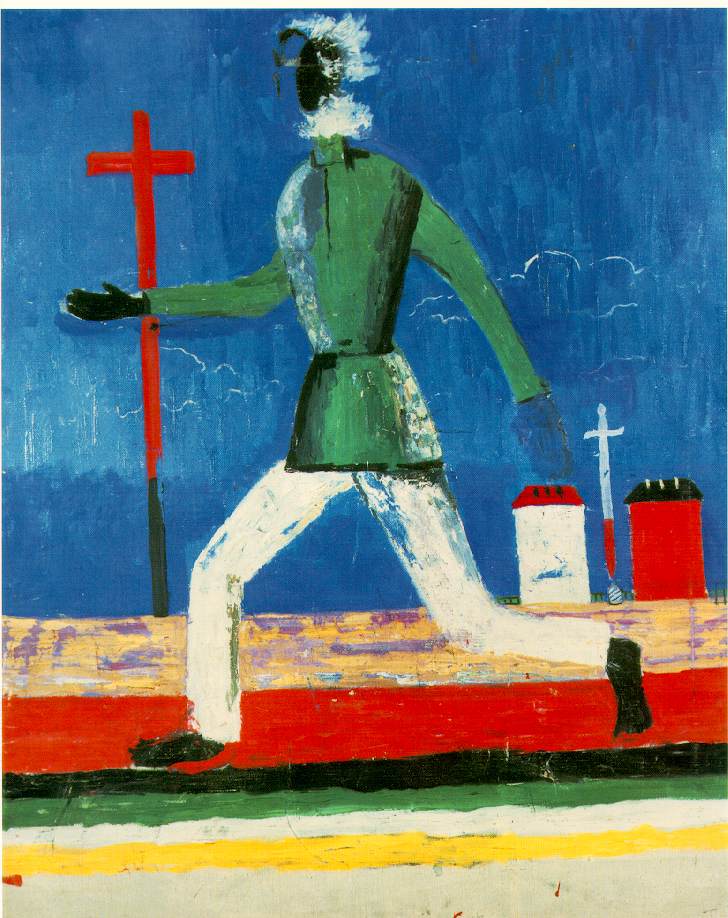
    Running Man -
    A Peasant Between Cross and Sword
    Kasimir Malevich
    ~1932-34
    There is great debate over the particulars of the Holodomor (Ukrainian: ะ“ะพะปะพะดะพะผะพั€). Was it an intentional artificial famine created by Stalin in order to force Communist collectivism on independent Ukraine? The unintentional result of the Bolsheviks' poor policy mixed with a poor harvest? Were Ukrainians specifically targeted for death or just coincidentally among the hardest hit? Just how many millions died? Did it even occur?

    The Ukrainian Greek-Catholic Church cannot be understood without understanding the history of oppression that Christian Ukraine has endured. One haunting piece of that puzzle that today's Ukrainian Greek-Catholics might directly recall is the Holodomor, though there aren't many who survived it.

    In Ukrainian, the word holod means "hunger", and mor means "plague". The expression moryty holodom means "to inflict death by hunger." This is the story of how atheistic Communism achieved that in 1930s Ukraine:


    It looks like a YouTube playlist bug is not allowing part 1 to show below.
    It is therefore posted above as a workaround while the rest of the video is below.

    Monday, January 17, 2011

    Our Lady of Wisdom Italo-Greek Byzantine Catholic Parish

    Monday's Map: We're traveling with the angels! 

    Today we're flying over to Las Vegas, Nevada, USA where you'll find the Italo-Greek Byzantine Catholic parish of Our Lady of Wisdom.


    The Italo-Greco-Albanian Catholic faithful primarily consist of the descendants of 15th and 16th Century Albanians who moved to the areas of Calabria and Sicily in Southern Italy. Our Lady of Wisdom is one of two Italo-Greek Catholic parishes in the United States. Since they have so few faithful in the US,  they are placed under the pastoral care of a local bishop, in this case His Grace, Bishop Gerald Nicholas Dino of the Ruthenian Eparchy of Phoenix. They therefore use Ruthenian liturgical books with some of their own retained customs such as touching their foreheads to the Gospels and chalice.

    The parish is a dynamic mix of people from diverse backgrounds. Their activities include religious education, small groups based on age and/or interests, an Irish folk music night, festivals, a prayer tree, regular liturgical services, a traveling icon for vocations, weekly devotionals, a mission location, and much more.

    Their website has a wealth of information including answers to many frequent questions. Check it out! http://ourladyofwisdom.net/

    Liturgy schedule:
    • Saturday 5:00 PM (Vesper Liturgy)
    • Sunday 10:00 AM (Third Hour)
    • Sunday 10:30 AM (Divine Liturgy)
    • Wednesday 7:00 PM (Akathist and Anointing of the Sick)

    The parish is currently served by the following:
    • Rt. Rev. Archimandrite Francis Vivona, S.T.M., J.C.L, Pastor
    • Rev. Deacon Stephen E. Casmus, M.A.
    • Ms. Rose Watkins, Christodoula
    • Mr. Joseph Cusumano, Permanent Counselor
    • Mr. William Griffith (Reigning Patriarch) and Ms. Kehaulani Harker (Reigning Matriarch)
    • Mrs. Toni Ritchey (Secretary) and Ms. Claire Lynott (Finance Officer)

    And in cartography news, here's what's happening with the Universal Map:
    • Jack Liu added a number of parishes to the map, primarily in Canada and California. Thank you!
    • This link explains how to view all map pages on one page, how to easily reorder the listings to group them by location, and other similar how-tos. If there are any problems figuring it out, let me know. I'm going to try the re-ordering this week.
    • If you have a google associated ID that you'd like me to "invite" as a "collaborator" to the map, it might make editing easier. The map is set to allow anyone to edit it, but I'm not clear if it functions differently for those specifically listed. Let me know if you'd like me to add you. 

    Monday's Map gives updates on the Universal Map project and highlights Eastern and Oriental Catholic institutions as well as those who run and serve them.

    Thursday, January 13, 2011

    Live Broadcast Tonight - Wedding Epistle


    Click on one to download
    text with which to pray
    along with Vespers:


    Loving as Christ loved the Church 
    St. John Chrysostom's homily on the epistle read at the wedding ceremony 
    Lecture by Deacon John Evancho

    Vespers at 6:30 PM Eastern Standard Time 
    Lecture at 8:00 PM Eastern Standard Time 

    "Saint John Chrysostom, the preeminent preacher in the Christian East, had a profound love for the Apostle Paul and his epistles. We will reflect on Chrysostom's inspiring homily on the Epistle reading for the sacramental Mystery of the Crowning in Marriage.

    Deacon John Evancho serves at Annunciation Byzantine Catholic Church in Homer Glen, Illinois. He is a member of the Byzantine Catholic Seminary Board of Directors. He received a Master of Theological Studies degree from Harvard Divinity School and BAs in Theology from Duquesne University and the Catholic University of Louvain (Belgium), as well as a JD from Harvard Law School. He and his wife, Laura, and their three young daughters, Ruth, Julia, and Sophia, live in Peoria, Illinois."

    Friday morning update: The talk was wonderful. It appears that a recording will be posted online. When it is, I'll post it here. 


    Theological Thursdays brings you homilies, lectures, interviews, and biographies on diverse topics including history, theology, spirituality, and philosophy as they pertain to the Eastern and Oriental Catholic Churches. 


    Tuesday, January 11, 2011

    The Domestic Church

    In Our Family and Home
    by Father Romanos Russo of St. Ann's Melkite Greek-Catholic Church
    Originally Published in Catholic Near East

    Our mothers and fathers must rediscover their role as priests of the home. The parents bless their children, the food that nourishes them, and preach the most eloquent of sermons by the nobility of their conduct. They enable their family to celebrate the fasts and feasts of the year. The children, too, should learn to assume roles in the domestic church as soon as practical: they can help read the daily scripture passages, assist in the preparation of the foods proper to their tradition and tend the light before the icons.
    Because the work is presumably still under copyright, I've only quoted a small portion of it. Read the entire article at St. Ann's website here.

    Talented Tuesdays is a feature which focuses on art, architecture, music, culture, food, and the running of the domestic church. User submitted questions and solutions are welcomed.


    Monday, January 10, 2011

    Ss. Peter and Paul UGCC Cathedral in Melbourne, AU

    Monday's Map: We're traveling with the angels!

    Today we're flying over to Melbourne, Victoria, Australia where you'll find the Ukrainian Greek-Catholic cathedral of Ss. Peter and Paul.

    The cathedral was featured in the 2007 book Windows to Heaven: the Icons of the Ukrainian Catholic Cathedral of Saints Peter and Paul in Melbourne which was written in both English and Ukrainian.

    Their eparchial website has a wealth of information including an Ask the Priest column and videos of services. Check it out! http://www.catholicukes.org.au/

    Liturgy schedule:
    • Sunday 8:00 AM (Recited Liturgy)
    • Sunday 9:30 AM (Ukrainian Divine Liturgy)
    • Sunday 11:30 AM (English Divine Liturgy)
    • Weekdays 9:00 AM (Divine Liturgy)
    The cathedral is currently served by the following clergy:
    • Most Rev. Peter Stasiuk C.Ss.R. (Bishop)
    • Rt. Rev. Mitrat Olexander Kenez (Chancellor/Protosynce), Fr. Felix Figureะบ (Administrator), Rt. Rev. Mitrat Zenon Chorkawyj, Very Rev. Fr. Peter Struk, Fr. Robert Stickland, Fr. Brian Kelty
    • Rev. Deacon Edward Kostraby
    And in cartography news, here's what's happening with the Universal Map:
    • I updated several UGCC parishes in Australia, mostly changing the title from "Ukrainian Catholic Church" to the parish's full name.
    • I added several Australian UGCC parishes that weren't previously on the universal map.
    • I created place markers for five UGCC parishes that were not previously marked in Google Maps as businesses/churches.
    • I sent emails to the administrators of the 5 newly-added parishes to let them know that a postcard will arrive in the mail in 2-3 weeks with a pin number that I must enter in order for the church to be labeled on Google Maps. (If your priest receives one, please let him know it is legit.)
    Monday's Map gives updates on the Universal Map project and highlights Eastern and Oriental Catholic institutions as well as those who run and serve them.

    Friday, January 7, 2011

    Fasting in the Byzantine Church Year

    Whether you're on the Gregorian calendar and are therefore in the post-feast of Theophany/Epiphany or you're celebrating Christmas according to the Julian calendar today, this oldie but goodie should fit the bill! Aren't you glad that the fasts end in feasts?


    Friday's Fast features homilies, lectures, interviews, and biographies on topics such as prayer, fasting, almsgiving, and repentance. For in the cross of Christ crucified lies both the power of God and the wisdom of God for those being saved (I Corinthians 1:24).
    Related Posts Plugin for WordPress, Blogger...