Pages

Showing posts with label Videos. Show all posts

Sunday, May 8, 2011

Happy Mother's Day!

By singing praise to your maternity, we exalt you as a spiritual temple, Theotokos. For the One Who dwelt within your womb, the Lord who holds all things in his hands, sanctified you, glorified you, and taught all to sing to you...


Step-mothers, single mothers, biological mothers, adoptive mothers, estranged mothers, birth mothers, natural mothers, first mothers, religious mothers, spiritual mothers, foster mothers, grand-mothers, godmothers, mothers whose children died in miscarriage or abortion, mothers who placed their children for adoption, mothers whose children live with others, mothers whose children live at home, mothers who made poor decisions, mothers who were not able or allowed to parent, mothers who have sacrificed greatly, mothers whose children are still growing in their wombs or are waiting for them around the world, mothers whose children are grown and gone, mothers whose sons and daughters are in harm's way as they protect and defend others, mothers who visit their children's graves, mothers whose children have no graves at which they can sit and grieve...


However you came to be a mother and wherever your children now are, I pray today as the English world celebrates Mother's Day that our Lord shower you with graces just as He did for His own mother and that the Theotokos--she who bore and gave birth to God and who stood at the foot of the cross as He died upon it--will pray for the salvation of you and your children.

O never failing protectress of Christians and their ever-present intercessor before the Creator; despise not the petitions or sinners who have recourse to you, by your goodness extend your help to us to call upon you with confidence. Hasten, O Mother of God, to intercede for us, for you have always protected those who honor you.

Friday, April 22, 2011

Pope Addresses Iraqi Christians

I am looking for the full video of the Q&A session that Pope Benedict televised live today. He chose 7 questions on suffering to respond to on Good Friday. One of the questions was from Iraqi Christians. Here's an overview:

Wednesday, April 20, 2011

Untouchable Converts

In India, the Hindu caste system is one of numerous sources of interreligious tension and persecution, especially as those from the lowest castes convert to Christianity. They often take their caste designation with them, being considered Dalit Christians, or converts from the Islamic or Hindu untouchables caste.

In 2008, these Christians in India were systemically targeted by Hindu fundamentalist mobs who blamed Christians for the murder of a Hindu leader. Police exonerated the Christian community, which has been in India since the earliest days of Christianity, but their houses were still burned, many brutally murdered, and thousands driven from their homes. Here's a newscast from the time:


Wednesday's Wages are a series of posts which highlight past and present struggles faced by Eastern and Oriental Catholics including the topics of bioethics and persecution. Do you know of a homily, lecture, interview or biography which you think should be featured here? Leave a comment to let me know.

Tuesday, April 12, 2011

Pysanky

Father Paul Luniw of St. Michael's Ukrainian Greek-Catholic Church in Terryville, Connecticut demonstrates the art of making pysanky.


Talented Tuesdays is a feature which focuses on art, architecture, music, culture, food, and the running of the domestic church. User submitted questions and solutions are welcomed.


Tuesday, April 5, 2011

Frescoes at Mar Musa Monastery

The Monastery of Saint Moses the Abyssinian (Deir Mar Musa al-Habashi, دير مار موسى الحبشي) is a Syriac Catholic monastic community of monks and nuns that is situated near the town of Nabk, Syria. The monastery is focused on religious dialogue particularly between Muslims and Christians. It's also the home to some beautiful medieval frescoes. The monastery's website can be found here.
From archaeological and historical evidence, we know that the monastery of St. Moses existed from the middle of the 6th century and belonged to the Syrian Antiochian Rite. The present monastic church was built in the Islamic year 450 (1058 AD), according to Arabic inscriptions on the walls, which begin with the words: "In the name of God the Merciful, the Compassionate".
The frescoes in the church date from the 11th and 12th centuries.
In the 15th century the monastery was partially rebuilt and enlarged. The monastery was abandoned in the first half of the 19th century and slowly fell into ruin. Nevertheless, it remained in the ownership of the Syrian Catholic Diocese of Homs, Hama and Nabk. The inhabitants of Nabk continued to visit the monastery with devotion and the local parish struggled to maintain it.
In 1984, restoration work began through a common initiative of the Syrian State, the local Church and a group of Arab and European volunteers. The restoration of the monastery building was completed in 1994 thanks to co-operation between the Italian and Syrian States. This Italian and Syrian school for restoration of frescoes was created at Deir Mar Musa in 1989 and will complete the restoration of the frescoes in the context of Syrian European co-operation. 
Read more about the church's frescoes as well as their architectural, agricultural, and interreligious dialog efforts here.


Talented Tuesdays is a feature which focuses on art, architecture, music, culture, food, and the running of the domestic church. User submitted questions and solutions are welcomed.


Wednesday, March 30, 2011

Ukraine: A Forgotten Generation

Aid to the Church in Need, an international Catholic charity under the guidance of the Pope, made the below video to discuss the plight of Ukrainian children following the fall of Communism. It specifically addresses how the Communist Persecution affected the Ukrainian Greek-Catholic Church's ability to provide social and educational care to the poor.


Wednesday's Wages are a series of posts which highlight past and present struggles faced by Eastern and Oriental Catholics including the topics of bioethics and persecution. Do you know of a homily, lecture, interview or biography which you think should be featured here? Leave a comment to let me know.

Wednesday, January 19, 2011

Ukrainian Holodomor

Wednesday's Wages 
Recalling that it was for only 30 silver shekels that Judas betrayed the Lord 

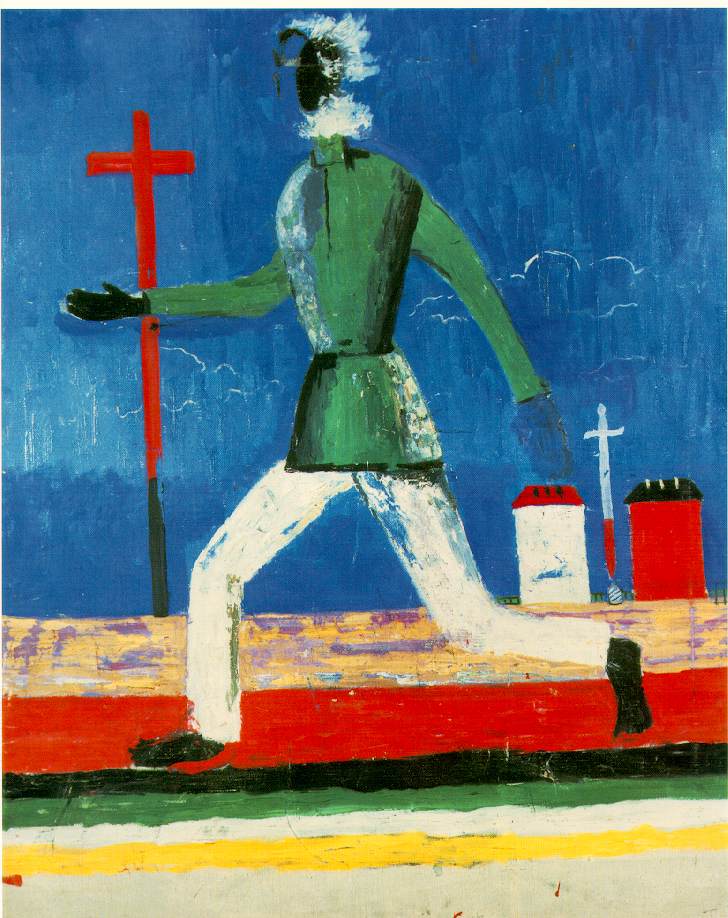
Running Man -
A Peasant Between Cross and Sword
Kasimir Malevich
~1932-34
There is great debate over the particulars of the Holodomor (Ukrainian: Голодомор). Was it an intentional artificial famine created by Stalin in order to force Communist collectivism on independent Ukraine? The unintentional result of the Bolsheviks' poor policy mixed with a poor harvest? Were Ukrainians specifically targeted for death or just coincidentally among the hardest hit? Just how many millions died? Did it even occur?

The Ukrainian Greek-Catholic Church cannot be understood without understanding the history of oppression that Christian Ukraine has endured. One haunting piece of that puzzle that today's Ukrainian Greek-Catholics might directly recall is the Holodomor, though there aren't many who survived it.

In Ukrainian, the word holod means "hunger", and mor means "plague". The expression moryty holodom means "to inflict death by hunger." This is the story of how atheistic Communism achieved that in 1930s Ukraine:


It looks like a YouTube playlist bug is not allowing part 1 to show below.
It is therefore posted above as a workaround while the rest of the video is below.

Tuesday, January 18, 2011

Armenian Coffee and Fruit

In honor of the Nineveh Fast that the Armenian Catholic Church, among others, will soon undertake in memory of the three days Jonah was in the belly of the fish, I bring you this glimpse into Armenian culture and food. It is traditional for Armenians to completely refrain from food and drinks over the three day fast. Abstaining from meat, dairy, and fish during the fast are still considered minimal expectations.

Armenian food is distinguished from other Mediterranean diets by its heavy emphasis on using fresh and ripe produce, few spices, and a lot of bulgur. There's one fruit that stands out in the mix:
I like to eat many fruits and vegetables. Maybe this comes from the fact that I am from Armenia, the place that is rich in fruits and veggies. But there is one fruit that I like most of all, and which has a special meaning for me. I think the reason again is the fact that I am Armenian.  -Marina Hovhannisyan; Krupnick Essay Contest Winner, 2006 
Because the work is presumably still under copyright, I've only quoted a small portion of it. Make yourself a cup of Armenian coffee following the directions below, then settle in to read the short essay about Armenia's national fruit at the Los Angeles Valley College's website here.


Talented Tuesdays is a feature which focuses on art, architecture, music, culture, food, and the running of the domestic church. User submitted questions and solutions are welcomed.


Thursday, January 13, 2011

Live Broadcast Tonight - Wedding Epistle


Click on one to download
text with which to pray
along with Vespers:


Loving as Christ loved the Church 
St. John Chrysostom's homily on the epistle read at the wedding ceremony 
Lecture by Deacon John Evancho

Vespers at 6:30 PM Eastern Standard Time 
Lecture at 8:00 PM Eastern Standard Time 

"Saint John Chrysostom, the preeminent preacher in the Christian East, had a profound love for the Apostle Paul and his epistles. We will reflect on Chrysostom's inspiring homily on the Epistle reading for the sacramental Mystery of the Crowning in Marriage.

Deacon John Evancho serves at Annunciation Byzantine Catholic Church in Homer Glen, Illinois. He is a member of the Byzantine Catholic Seminary Board of Directors. He received a Master of Theological Studies degree from Harvard Divinity School and BAs in Theology from Duquesne University and the Catholic University of Louvain (Belgium), as well as a JD from Harvard Law School. He and his wife, Laura, and their three young daughters, Ruth, Julia, and Sophia, live in Peoria, Illinois."

Friday morning update: The talk was wonderful. It appears that a recording will be posted online. When it is, I'll post it here. 


Theological Thursdays brings you homilies, lectures, interviews, and biographies on diverse topics including history, theology, spirituality, and philosophy as they pertain to the Eastern and Oriental Catholic Churches. 


Wednesday, January 12, 2011

Maafa 21: Genocide in the United States

Wednesday's Wages 
Recalling that it was for only 30 silver shekels that Judas betrayed the Lord 

Many Eastern and Oriental Catholics in the United States are direct targets of the American eugenics movement which seeks to eliminate poverty by eliminating the poor and desires to create a master race of healthy, attractive, fair-skinned, educated, wealthy individuals of northern European descent. They taught Hitler a large part of his eugenics theories and practices and they remain active in the United States today. This explains their why and how.

At that time, they did shift over to what they called "the quality of life." It was a philosophy unquestionably used to target the poor simply because what the quality of life at its core meaning was that poor people really didn't have a reason to live. Only the white--those with status--had any chance of a "meaningful" or "purposeful" life. The solution for the poor now was not to eliminate the circumstances that would cause poverty. Their solution now was to eliminate the poor--eliminate the impoverished--and just wipe them off the face of the earth. -Clenard Childress (Northeast Director of Life Education and Resource Network) 
Wednesday's Wages are a series of posts which highlight past and present struggles faced by Eastern and Oriental Catholics including the topics of bioethics and persecution. Do you know of a homily, lecture, interview or biography which you think should be featured here? Leave a comment to let me know.  

Friday, January 7, 2011

Fasting in the Byzantine Church Year

Whether you're on the Gregorian calendar and are therefore in the post-feast of Theophany/Epiphany or you're celebrating Christmas according to the Julian calendar today, this oldie but goodie should fit the bill! Aren't you glad that the fasts end in feasts?


Friday's Fast features homilies, lectures, interviews, and biographies on topics such as prayer, fasting, almsgiving, and repentance. For in the cross of Christ crucified lies both the power of God and the wisdom of God for those being saved (I Corinthians 1:24).

Saturday, January 1, 2011

St. Mary's Coptic Catholic Church in Los Angeles

If you're near LA, check out St. Mary's Coptic Catholic Church.
2701 Newell St.
Los Angeles, California 90039
And if you aren't close by, check them out online: http://stmaryccc.com/


Video transcript as translated by Free Translation and modified slightly by Catherine Alexander.


The Coptic Catholic Church
The biblical sources (Actions and Letters) do not speak of the evangelization of Egypt. Tradition attributes the foundation of this Church to the Evangelist Mark. But the Coptic Church has also the merit of having given life, in the 4th Century, to the monastic tradition. An impressive phenomenon that spread itself from Egypt first to the East (Palestine, Syria, Cappadocia) and then to all of the west. The statistics relating to the Copts in Egypt say that from a population of about 75 million residents, the Coptic number of Christians changes to second if to supply the is the Muslim government or the church. The Coptic Orthodox are estimated to be between 6 and 9 million. The faithful Coptic Catholic are about 250,000, subdivided in seven diocese in Egypt and 13 parishes in foreign countries. They are served from nine bishops, beneficiaries from 200 priests and Franciscan monks, in 174 parishes in Egypt, but also in Europe, North America, Australia and the Middle East. Since the 7th Century, the Coptic tongue was often replaced by the Arabic tongue, and today the liturgical books present a bilingual text, Coptic and Arabic, mixed here and there with Greek formulas, restive of the original tongue. The Catholic formation of a Coptic community in Egypt derives from the work carried out of preaching first from the Franciscan, that in 1630 were based on a mission to the Cairo, and later on, post 1675, also from the Jesuits. "The Church of Egypt is passed across periods a lot more difficult and harder. You make sentences of true persecution". To affirm the S. B Mons. Antonio Naguib, Coptic Patriarch Catholic - that continues: "But it is gone out of it stronger and more dynamic. As for the future, once again, we put ourselves between the hands of God, with much trust and hope."
Related Posts Plugin for WordPress, Blogger...