
 |
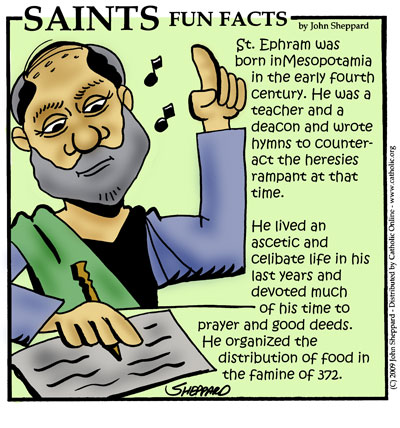
| Picture by John Sheppard and courtesy of Catholic.org |
The most important of his works are his lyric, teaching hymns (madrāšê). These hymns are full of rich, poetic imagery drawn from biblical sources, folk tradition, and other religions and philosophies. The madrāšê are written in stanzas of syllabic verse, and employ over fifty different metrical schemes. Each madrāšâ had its qālâ, a traditional tune identified by its opening line. All of these qālê are now lost. It seems that Bardaisan and Mani composed madrāšê, and Ephrem felt that the medium was a suitable tool to use against their claims. The madrāšê are gathered into various hymn cycles. Each group has a title — Carmina Nisibena, On Faith, On Paradise ... Against Heresies — but some of these titles do not do justice to the entirety of the collection (for instance, only the first half of the Carmina Nisibena is about Nisibis). Each madrāšâ usually had a refrain (‘ûnîṯâ), which was repeated after each stanza. Later writers have suggested that the madrāšê were sung by all women choirs with an accompanying lyre.
Particularly influential were his Hymns Against Heresies. Ephrem used these to warn his flock of the heresies which threatened to divide the early church. He lamented that the faithful were "tossed to and fro and carried around with every wind of doctrine, by the cunning of men, by their craftiness and deceitful wiles." He devised hymns laden with doctrinal details to inoculate right-thinking Christians against heresies such as docetism. The Hymns Against Heresies employ colourful metaphors to describe the Incarnation of Christ as a fully human and divine. Ephrem asserts that Christ's unity of humanity and divinity represents peace, perfection and salvation; in contrast, docetism and other heresies sought to divide or reduce Christ's nature, and in doing so would rend and devalue Christ's followers with their false teachings.
Ephrem also wrote verse homilies (mêmrê). These sermons in poetry are far fewer in number than the madrāšê. The mêmrê are written in a heptosyllabic couplets (pairs of lines of seven syllables each).
The third category of Ephrem's writings is his prose work. He wrote biblical commentaries on the Diatessaron (the single gospel harmony of the early Syriac church), on Genesis and Exodus, and on the Acts of the Apostles and Pauline Epistles. He also wrote refutations against Bardaisan, Mani, Marcion and others.
Ephrem wrote exclusively in the Syriac language, but translations of his writings exist in Armenian, Coptic, Georgian, Greek and other languages. Some of his works are only extant in translation (particularly in Armenian). Syriac churches still use many of Ephrem's hymns as part of the annual cycle of worship. However, most of these liturgical hymns are edited and conflated versions of the originals.
The most complete, critical text of authentic Ephrem was compiled between 1955 and 1979 by Dom Edmund Beck OSB as part of the Corpus Scriptorum Christianorum Orientalium.
Source: Wikipedia's article on Ephrem the Syrian/Writings
1.1 Christ Adam and the Fast
The is the fast of the First Born, the first of his victories.
Let us rejoice in his coming; for in fasting he has overcome.
Though he could have overcome by any means,
He revealed for us the strength hidden in fasting, Overcomer of All.
For by means of it a man can overcome that one who with fruit overcame Adam;
He became greedy and gobbled it. Blessed is the First-Born who encompassed
Our weakness with the wall of his great fasting.
Res:
Blessed is the King who adorned the Holy Church with Fasting, Prayer and Vigil.
1.2 The Fast Purifies the Eye of the Soul to See God
This is the fast which exalts; which appeared from the First Born
So as to extol the younger ones. There is occasion for delight for the discerning ones in fasting;
When one sees how much he has grown. Fasting secretly purifies the soul
So it can gaze on God and grow by the vision of Him.
For the weight that is from the earth, bends it back to the earth.
Blessed is he who gave us fasts,
The sheer wings by which we fly to him.
1.3
Fasting is bright and beautiful for any who bright enough
To gaze on God. The Turbid One, stirred up by anything
Cannot fix the eye on that Clear One. He who possesses a clear eye
He can gaze upon him; as much as it is given to him to gaze.
Instead of the clarifying wine, let us clarify our thought
So that we will be able to see the Clear One
Who overcame the Evil Oneby means of fasting, that Disturber of All.
1.4 The Fast and the Temptation of the Lord
This is the fast through which greed escapes
The peoples at the top of the mountain ; clothed in fasting he overcame the Greedy One.
Who had clothed himself with the food of Adam's house.
The Lord of Victories gave us his weapon, he ascended on high to be an observer.
Who would not run to the weapon by which God overcame
It is a shameful thing, my brothers, to be bested by the weapon
Which overcomes and causes to overcome all creation.
1.5 The Fast Lets One See the Invisible Enemy
Because the enemy is not visible, let us purge our thinking so that he sees that we see him.
He is able to steal some of those whom he sees
That they have not noticed him.
When a soul undertakes a fast,
The the fast bears it and gives it back to its counterpart.
Amid the volleys of sharpened arrows, hiddren from view, the hidden eye
Is polished to see from whence they come.
1.6 The True Fast and the Scriptures
This is the instructive fast, it teaches the athlete the ways of the contest.
Draw near to it, study, learn to struggle shrewdly.
Behold he instructed us to fast with our mouths and hearts,
Let us not fast from bread and think thoughts
In which the hidden poison of death is hidden.
Let us confess on the fast day the First Born
Who gave us the word of life to meditate on.
1.7
Let the scriptures be for us like a mirror, let us see in them our fast
For the Bible descriminates between fasts and prayer.
It chooses one type of fast and rejects another
Some fasters appease God and others anger him.
There is a prayer which is sinful, and another which is the medicine of life
O Lord let us rejoice in our fast
As he rejoiced, my brothers, in his own fast.
1.8 The Fast of Christ
The fast is not defiling for the Holy One, for through it he descended and shone
Another mixing made the fast defiled, though itself is pure.
Examine nature! Are not desirable fruit
Polluted by loathsome fruit?
Our thoughts are repelled by them though they be washed many times.
Blessed is the Pure One who receives those fruits
Which all the penitent having purified them give to him.
1.9 The Effort of the Enemy to Make the Fast of No Use
The Troubler mixes filth with our Clarity,
So as to make the first-fruits of our prayer and fasting hateful.
It is possible by his jealousy, that our gift be rebuked.
Take away your deceits from your fasts, remove mockery from your praise.
May your voices wash your mouths from lies.
Allow us, O First Born in your mercy
To uproot hidden weeds from our thoughts
1.10
Do not be hindered O Simple Ones regarding that Deceiver who robs Fasters.
For when he sees someone abstaining from bread,
He is filled with anger. When he sees someone standing to pray
He fills his mind with one distraction after another.
He steals from his heart the prayer of his mouth,
O Lord of ours give us an eye to see,
How he steals the truth in deceit.
1.11
Come be gathered, my brothers, on this fast day let us sit and marvel at how evil is the Evil One
When he makes a transaction (gives and takes), he impoverishes us by what is his.
And does he become wealthy through what is ours; the truth that he steals suits him not.
The deceit he gives to us does not avail.
It is similar to the whore his companion, who is neither ours nor his.
Judge O Lord, between us and him,
For it is through you that Solomon judged the unclean women.
1.12 The False Fast of the Jews
Let us seek the trace of truth on the fast day; Let us go forth by it to the place of abodes
For the Blind People run, on a fast day with pride and wandering
Though there is a fast in their mouth, yet an idol is in the heart;
Prayer is on their lips, but divination in their heart
Their stomach is devoid of bread, but full of lies;
Though they wash their hands all day,
Hidden blood still screams against them.
1.13 Ephrem's Lament
Blessed is he who endured and sustained and his head is crowned in exaltation.
With a bold voice, as one who deserves a payment, he demands his wage
He is not like me, who is too weak to fast, too lowly for the vigil
The first to be overcome. My enemy possesses skill
When he overcomes me, he lets me rise that he might again cast me low.
O Sea of mercies give me a handful of mercies
Source: Saint Ephrem's Hymns on Fasting: An Annotated Translation and Concordance by Gary A. Anderson, Sidney Griffith, and Robin Darling Young
Theological Thursdays brings you homilies, lectures, interviews, and biographies on diverse topics including history, theology, spirituality, and philosophy as they pertain to the Eastern and Oriental Catholic Churches.
1.1 Christ Adam and the Fast
The is the fast of the First Born, the first of his victories.
Let us rejoice in his coming; for in fasting he has overcome.
Though he could have overcome by any means,
He revealed for us the strength hidden in fasting, Overcomer of All.
For by means of it a man can overcome that one who with fruit overcame Adam;
He became greedy and gobbled it. Blessed is the First-Born who encompassed
Our weakness with the wall of his great fasting.
Res:
Blessed is the King who adorned the Holy Church with Fasting, Prayer and Vigil.
1.2 The Fast Purifies the Eye of the Soul to See God
This is the fast which exalts; which appeared from the First Born
So as to extol the younger ones. There is occasion for delight for the discerning ones in fasting;
When one sees how much he has grown. Fasting secretly purifies the soul
So it can gaze on God and grow by the vision of Him.
For the weight that is from the earth, bends it back to the earth.
Blessed is he who gave us fasts,
The sheer wings by which we fly to him.
1.3
Fasting is bright and beautiful for any who bright enough
To gaze on God. The Turbid One, stirred up by anything
Cannot fix the eye on that Clear One. He who possesses a clear eye
He can gaze upon him; as much as it is given to him to gaze.
Instead of the clarifying wine, let us clarify our thought
So that we will be able to see the Clear One
Who overcame the Evil Oneby means of fasting, that Disturber of All.
1.4 The Fast and the Temptation of the Lord
This is the fast through which greed escapes
The peoples at the top of the mountain ; clothed in fasting he overcame the Greedy One.
Who had clothed himself with the food of Adam's house.
The Lord of Victories gave us his weapon, he ascended on high to be an observer.
Who would not run to the weapon by which God overcame
It is a shameful thing, my brothers, to be bested by the weapon
Which overcomes and causes to overcome all creation.
1.5 The Fast Lets One See the Invisible Enemy
Because the enemy is not visible, let us purge our thinking so that he sees that we see him.
He is able to steal some of those whom he sees
That they have not noticed him.
When a soul undertakes a fast,
The the fast bears it and gives it back to its counterpart.
Amid the volleys of sharpened arrows, hiddren from view, the hidden eye
Is polished to see from whence they come.
1.6 The True Fast and the Scriptures
This is the instructive fast, it teaches the athlete the ways of the contest.
Draw near to it, study, learn to struggle shrewdly.
Behold he instructed us to fast with our mouths and hearts,
Let us not fast from bread and think thoughts
In which the hidden poison of death is hidden.
Let us confess on the fast day the First Born
Who gave us the word of life to meditate on.
1.7
Let the scriptures be for us like a mirror, let us see in them our fast
For the Bible descriminates between fasts and prayer.
It chooses one type of fast and rejects another
Some fasters appease God and others anger him.
There is a prayer which is sinful, and another which is the medicine of life
O Lord let us rejoice in our fast
As he rejoiced, my brothers, in his own fast.
1.8 The Fast of Christ
The fast is not defiling for the Holy One, for through it he descended and shone
Another mixing made the fast defiled, though itself is pure.
Examine nature! Are not desirable fruit
Polluted by loathsome fruit?
Our thoughts are repelled by them though they be washed many times.
Blessed is the Pure One who receives those fruits
Which all the penitent having purified them give to him.
1.9 The Effort of the Enemy to Make the Fast of No Use
The Troubler mixes filth with our Clarity,
So as to make the first-fruits of our prayer and fasting hateful.
It is possible by his jealousy, that our gift be rebuked.
Take away your deceits from your fasts, remove mockery from your praise.
May your voices wash your mouths from lies.
Allow us, O First Born in your mercy
To uproot hidden weeds from our thoughts
1.10
Do not be hindered O Simple Ones regarding that Deceiver who robs Fasters.
For when he sees someone abstaining from bread,
He is filled with anger. When he sees someone standing to pray
He fills his mind with one distraction after another.
He steals from his heart the prayer of his mouth,
O Lord of ours give us an eye to see,
How he steals the truth in deceit.
1.11
Come be gathered, my brothers, on this fast day let us sit and marvel at how evil is the Evil One
When he makes a transaction (gives and takes), he impoverishes us by what is his.
And does he become wealthy through what is ours; the truth that he steals suits him not.
The deceit he gives to us does not avail.
It is similar to the whore his companion, who is neither ours nor his.
Judge O Lord, between us and him,
For it is through you that Solomon judged the unclean women.
1.12 The False Fast of the Jews
Let us seek the trace of truth on the fast day; Let us go forth by it to the place of abodes
For the Blind People run, on a fast day with pride and wandering
Though there is a fast in their mouth, yet an idol is in the heart;
Prayer is on their lips, but divination in their heart
Their stomach is devoid of bread, but full of lies;
Though they wash their hands all day,
Hidden blood still screams against them.
1.13 Ephrem's Lament
Blessed is he who endured and sustained and his head is crowned in exaltation.
With a bold voice, as one who deserves a payment, he demands his wage
He is not like me, who is too weak to fast, too lowly for the vigil
The first to be overcome. My enemy possesses skill
When he overcomes me, he lets me rise that he might again cast me low.
O Sea of mercies give me a handful of mercies
Source: Saint Ephrem's Hymns on Fasting: An Annotated Translation and Concordance by Gary A. Anderson, Sidney Griffith, and Robin Darling Young
Theological Thursdays brings you homilies, lectures, interviews, and biographies on diverse topics including history, theology, spirituality, and philosophy as they pertain to the Eastern and Oriental Catholic Churches.


