Pages

Showing posts with label Theological Thursdays. Show all posts

Sunday, November 6, 2016

The Bible in the Domestic Church

Catherine Speaking at the Eastern Catholic Bible Conference
Photo by Nick Havrilla, Sr
I spoke at the first ever Eastern Catholic Bible Conference yesterday on the topic of the Bible in the Domestic Church. Several asked me for the recording or transcript of my talk and for a copy of the documents I referenced, so here they are!

The Bible In the Domestic Church Parts 1-4 (Full transcript)
Parts 1, 2, 3, and 4 of my talk combined into a single document for easy use.

Who is God?
Part 1 of my talk, covering the Trinitarian communion of God and the incarnation and virgin birth of Jesus

Who am I?
Part 2 of my talk, covering personhood and being and rebirth through Baptism, Chrismation, and the Eucharist

To What am I Called?
Part 3 of my talk, covering the vocations of celibacy and marriage and their associated spiritualities and communities

How Do I Live Out My Calling?
Part 4 of my talk, covering practical and attainable ways to grow within the domestic church, during which the below resources were mentioned

Resources for the Domestic Church
A short list of recommendations to share some of the options available out there to inform and support the work of the domestic church

When Eastern Catholics Commune at a Roman Catholic Mass Pamphlet
A single-page pamphlet addressing the most common questions and practicalities related to intra-Church communion including the canonical foundation, babies and young children receiving the Eucharist, and how the topic can be approached.

Byzantine Morning Prayer for Adults
A single-page morning prayer rule for adults which focuses on spiritual growth through the Byzantine tradition

Byzantine Morning and Evening Prayer for Families
A single-page morning and evening prayer rule for families which introduces the Byzantine tradition and encourages continued growth in a sustainable way

Byzantine Examination of Conscience for Married Parents, Married Adults, Single Parents, Single Adults, Clergy and Religious, Youth, and Children
A series of compatible examinations which encourage continued spiritual growth through the full life span, each on a single page and tailored to the needs of a different demographic.

Byzantine Examination of Conscience in a Visual Format (pictures)
A single-page examination that has a picture accompanying each point, followed by a series of cards that can be cut out (and laminated and/or placed on a ring if desired) to use one at a time, including the option of selecting only those that have been a challenge to take into Confession. Particularly helpful for pre-readers, those with learning differences or attention constraints, and those with disabilities.

Byzantine Rule of Repentance with a Byzantine Confession Guide for Adults, Simplified, and in a Visual Format (pictures)
A single-page prayer rule in preparation for Confession (most suitable for teens through adults) with a Confession guide for every age and ability, including a visual format which is particularly helpful for pre-readers, those with learning differences or attention constraints, and those with disabilities.

Morning prayer, evening prayer, rule of repentance, and Confession guide designed to optimize the prayers needed for Mass and the most popular Latin/Roman devotions, most to all of the prayers also on the list of indulgences.


Saturday, December 10, 2011

Church Ascription Upon Conversion


Fr. George Gallaro is one of my heroes. In case you don't remember who he is, you can read his impressive credentials on this previous post. I've written him twice asking him to share his wisdom with all of us through this blog. Twice he has written me back almost immediately with a wealth of wisdom to share.

This is a topic I've received several requests to cover and have seen a lot of confusion over. I'm grateful that Father George shared it here with us and think it will be referenced frequently. I'm also grateful that he took the time to put it into text because I suspect these words will be searched on a regular basis. He gives the canonical low-down on joining a church sui juris when converting.

BAPTIZED NON-CATHOLICS 
COMING INTO FULL COMMUNION 
WITH THE CATHOLIC CHURCH
Fr. George Gallaro

The Second Vatican Council declares in its Decree on Ecumenism (Unitatis redintegratio) that, when those who have been validly baptized in non-Catholic Churches or Ecclesial Communities spontaneously ask to enter full communion with the Catholic Church, either as individuals or as groups, “it is necessary to impose no burden beyond what is essential.” (UR 18)

The Code of Canons of the Eastern Churches (i.e. CCEO) in its canon 897 affirms that: “A member of the Christian faithful of an Eastern non-Catholic Church is to be received into the Catholic Church with only the profession of the Catholic faith, after a doctrinal and spiritual preparation that is suited to that person’s condition.” Since this constitutes a very delicate act, it is advisable to ascertain the weighty reasons why one asks for admission into the Catholic Church.

The competent ecclesiastical authority to receive one into full communion is specified in the CCEO in the canons 898-899.

The same Code in canon 35, following the Decree on the Eastern Churches (Orientalium ecclesiarum), declares that: “Baptized non-Catholics coming into full communion with the Catholic Church should retain and practice their own rite and should observe it everywhere in the world as much as humanly possible.” In the case of Orthodox, the new Church of ascription shall be one of the autonomous Eastern Catholic Churches, the closest in its ritual approach.

Protestants who enter into the full Catholic communion are to be ascribed to the Latin Church, since their Ecclesial Communities sprang from the Western/Latin tradition.

The rationale of this norm is mainly ecclesiological: full communion with the apostolic Church of Rome does not imply alienation or loss of the rite, understood as liturgical, theological, spiritual and disciplinary patrimony. Canon 35 was written with an ecumenical perspective in mind: to establish and to preserve communion one must “lay no greater burden than necessary” (Acts 15: 28).

The Eastern Orthodox who joins the equivalent Eastern Catholic Church finds the surroundings in keeping with his/her Christian history and identity. That does not mean that he/she cannot continue to attend the Latin Church, even though it is desirable that he/she should be helped to uphold his/her own Church tradition.

Since the text of canon 35 does not explicitly specify if the norm is for validity or for lawfulness, one may infer that this is not an irritating law.

Canon 32 §1, dealing with Catholics who desire to transfer validly to another autonomous Catholic Church, requires the consent of the Holy See. Furthermore, insofar as legitimate ascription to another autonomous Catholic Church constitutes the basis for the validity or lawfulness of certain juridical act (e.g., the validity of a marriage or the lawful admission to a religious institute of another autonomous Catholic Church) one may conclude that canon 35 has a binding force, after all.

Sometimes, a baptized member of an Eastern non-Catholic Church who enters in full communion with the Catholic Church wants to be ascribed into the Latin Church. If so, one must, with the prior approval of the local Latin bishop, seek an indult (i.e. permission) from the Holy See. The canonical reason for such a petition must be serious, e.g., the spiritual wellbeing of the petitioner or the unity of the family when the petitioner is married to a Latin spouse.

Thursday, May 5, 2011

When Easterners live in Western Territories - Part 2 of 3

Here is Part 2 of 3 from Fr. George Gallaro's discussion of canonical integration of Eastern faithful in Latin dioceses.


Duty of the Faithful to Observe Their Own Rite

The Vatican II decree On the Bishop’s Pastoral Office in the Church, Christus Dominus, states: “...Where there are faithful of a different rite, the diocesan bishop should provide for their spiritual needs either through priests or parishes of that rite or through an episcopal vicar endowed with the necessary faculties. Wherever it is fitting, the latter should also have episcopal rank …” This passage is confirmed by both current codes: CIC cc. 372 § 2, 383 § 2 & 518; CCEO cc. 193 & 280 § 1.

I would like to raise here two questions: Do Eastern faithful in the so-called diaspora have the right to this pastoral care or are they persons which arouse the generous solicitude of the Council Fathers? Furthermore, does not the implementation of this norm upset the internal equilibrium of the diocese and endanger the unity of the diocesan community?

The Latin Code answers to the first questions. In dealing with the obligations and rights of all the Christian faithful, its can. 214 states, “The Christian faithful have the right to worship God according to the prescripts of their own rite approved by the legitimate pastors of the Church and to follow their own form of spiritual life so long as it is consonant with the doctrine of the Church.” Although the first part of the canon seems to simply refer to the external ritual aspect of liturgical prayer, the second part, with its reference “to follow their form of spiritual life of the faithful,” opens new horizons.

The Latin Code uses here the term “rite” (ritus) as in Christus Dominus (CD 23,3) and Orientalium Ecclesiarum (passim), that is, as the synonym of a particular Church. The Latin Code thus underlines the inner element of rite, considered in its wider and fuller meaning, as indicatory of the face of each Church.

The Eastern Code, instead, stresses the extrinsic element of the individuality of the Eastern Churches by the supreme authority (there can be in fact several different Churches having in common the same liturgical tradition and spirituality). By using more precise terms, canon 17 of the Eastern Code eliminates every ambiguity: “The Christian faithful have the right to worship God according to the prescriptions of their own autonomous Church and to follow their own form of spiritual life in accord with the teachings of the Church.” This twofold right is so important - dealing with the spiritual life of the faithful - as to be part of the category “of the proper original elements of the ecclesiological and spiritual fabric of Vatican II,” or still as “an articulation of divine law.” In order to attain this specific right, the faithful enjoy another right, that of addressing their needs to their shepherds who in turn have the obligation to assist them.

Plurality of “Rites” in a Latin Diocese
The other question derives from the difficulty of some Latin bishops to meet the needs of their Eastern faithful for fear of throwing out of balance the unity of their diocese. To justify that, they call on can. 225 of the Latin Code which deals with the “general obligation and the right of individuals to work so that the divine message of salvation is made known” under the guidance of the ecclesiastical authority.

One cannot exclude that the carrying out of the right of the faithful to observe their own rite may sometimes encounter serious difficulties, as, for example, the small number of faithful of a particular rite scattered throughout a vast territory. On the whole, the fact that within a diocese there are ritual differences should not create any problem, as for the presence of different languages. On the contrary, the ritual differences enrich a local Church as a witness of the universality of the Christian message and the wealth of the Catholic Church. However, the Fathers of Vatican II clearly affirmed that the “variety of rites within the Church in no way harms her unity, but rather manifests it.” This text regards not only the Universal Church but also the Particular (Ritual) Churches.

The diocesan bishop, in his ministerial service, has to take care of all the faithful entrusted to him, including those who find themselves in singular circumstances. Vatican II and the two Codes, the Latin and the Eastern, clearly underline the bishop’s obligation towards the faithful of different ritual traditions, for whom he must, among other things, guarantee the right of fidelity to their ritual tradition.

The Eastern Code, more sensitive to this issue, dedicates one full canon (c. 193) to the bishop’s obligation towards the faithful of other autonomous Churches. In the first paragraph, “the eparchial bishop is bound by the serious obligation of providing everything so that these Christian faithful retain the rite of their respective Church ... and to ensure that they foster relations with the superior authority of their Church.” The next paragraph corresponds to the Council’s text and the mentioned Latin Code’s canon, while the third paragraph imposes to the eparchial bishop “to draw up a plan in consultation with the respective patriarchs (or major archbishops) for the care of these faithful.”


Tune in tomorrow to read part 3 where Fr. George explains what remedies and solutions are available to those issues raised by easterners in western territories...

Thursday, April 14, 2011

The Armenian Rite

The Armenian Catholic website has a short history on the development of the Armenian rite, explaining how it originally copied the Church of Jerusalem and then developed into its own rite in the following centuries.
The neighboring peoples' churches had already organized their adoration rules until Armenia became officially a Christian country in 301 due to The Illuminator and the Armenian church was constructed. The apostles Tatyos and Partoghomios did not let any trace of rite in our literature in Armenia. Before The Illuminator, when Christianity entered Armenia, due to the preachers of the Greek and Syriac churches, they brought with them to Armenia the adoration invented by their churches with the preaching of the Christian religion. This could not be different, because the Armenian Christianity and the Armenian church were going to be organized after three centuries from the Syriac and the Greek ones, while these two churches were going to have time to be organized before us, to progress, to have exceptional patriarchs and saints, who due to their help those churches improved and progressed, while we were still suffering from the paganism.
Read the rest here.

Theological Thursdays brings you homilies, lectures, interviews, and biographies on diverse topics including history, theology, spirituality, and philosophy as they pertain to the Eastern and Oriental Catholic Churches. 


Thursday, March 31, 2011

"We want our church to be alive"

Newly elected and enthroned Head of the Ukrainian Greek-Catholic Church His Beatitude Sviatoslav (Shevchuk) gave his first press-conference to Ukrainian journalists in Kyiv before his trip to Holy See and audience of Pope Benedict XVI.
He answers the questions "What awaits us, where are we going, where are we headed?" concerning the topics of unity of the Ukrainian Churches, the Ukrainian Greek Catholic Church strategy, the issue of patriarchal status for the Ukrainian Greek Catholic Church, relations with the Orthodox world, Catholic education, and missions in eastern Ukraine.


Theological Thursdays brings you homilies, lectures, interviews, and biographies on diverse topics including history, theology, spirituality, and philosophy as they pertain to the Eastern and Oriental Catholic Churches. 

<a href="http://risu.org.ua">Джерело публікації: risu.org.ua</a>

<a href="http://risu.org.ua">Джерело публікації: risu.org.ua</a>

Thursday, March 10, 2011

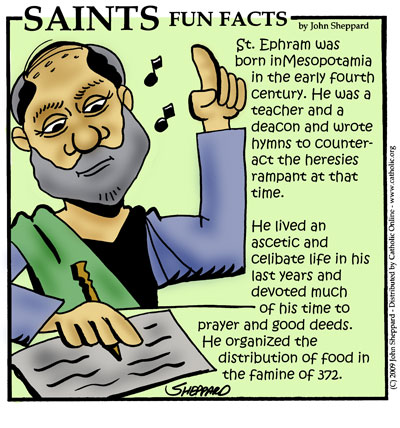
St. Ephrem's Hymn on Fasting

Picture by John Sheppard and courtesy of Catholic.org
Over four hundred hymns composed by Ephrem still exist. Granted that some have been lost, Ephrem's productivity is not in doubt. The church historian Sozomen credits Ephrem with having written over three million lines. Ephrem combines in his writing a threefold heritage: he draws on the models and methods of early Rabbinic Judaism, he engages skillfully with Greek science and philosophy, and he delights in the Mesopotamian/Persian tradition of mystery symbolism.

The most important of his works are his lyric, teaching hymns (madrāšê). These hymns are full of rich, poetic imagery drawn from biblical sources, folk tradition, and other religions and philosophies. The madrāšê are written in stanzas of syllabic verse, and employ over fifty different metrical schemes. Each madrāšâ had its qālâ, a traditional tune identified by its opening line. All of these qālê are now lost. It seems that Bardaisan and Mani composed madrāšê, and Ephrem felt that the medium was a suitable tool to use against their claims. The madrāšê are gathered into various hymn cycles. Each group has a title — Carmina Nisibena, On Faith, On Paradise ... Against Heresies — but some of these titles do not do justice to the entirety of the collection (for instance, only the first half of the Carmina Nisibena is about Nisibis). Each madrāšâ usually had a refrain (‘ûnîṯâ), which was repeated after each stanza. Later writers have suggested that the madrāšê were sung by all women choirs with an accompanying lyre.

Particularly influential were his Hymns Against Heresies. Ephrem used these to warn his flock of the heresies which threatened to divide the early church. He lamented that the faithful were "tossed to and fro and carried around with every wind of doctrine, by the cunning of men, by their craftiness and deceitful wiles." He devised hymns laden with doctrinal details to inoculate right-thinking Christians against heresies such as docetism. The Hymns Against Heresies employ colourful metaphors to describe the Incarnation of Christ as a fully human and divine. Ephrem asserts that Christ's unity of humanity and divinity represents peace, perfection and salvation; in contrast, docetism and other heresies sought to divide or reduce Christ's nature, and in doing so would rend and devalue Christ's followers with their false teachings.

Ephrem also wrote verse homilies (mêmrê). These sermons in poetry are far fewer in number than the madrāšê. The mêmrê are written in a heptosyllabic couplets (pairs of lines of seven syllables each).

The third category of Ephrem's writings is his prose work. He wrote biblical commentaries on the Diatessaron (the single gospel harmony of the early Syriac church), on Genesis and Exodus, and on the Acts of the Apostles and Pauline Epistles. He also wrote refutations against Bardaisan, Mani, Marcion and others.

Ephrem wrote exclusively in the Syriac language, but translations of his writings exist in Armenian, Coptic, Georgian, Greek and other languages. Some of his works are only extant in translation (particularly in Armenian). Syriac churches still use many of Ephrem's hymns as part of the annual cycle of worship. However, most of these liturgical hymns are edited and conflated versions of the originals.

The most complete, critical text of authentic Ephrem was compiled between 1955 and 1979 by Dom Edmund Beck OSB as part of the Corpus Scriptorum Christianorum Orientalium.

Source: Wikipedia's article on Ephrem the Syrian/Writings

1.1 Christ Adam and the Fast
The is the fast of the First Born, the first of his victories.
Let us rejoice in his coming; for in fasting he has overcome.
Though he could have overcome by any means,
He revealed for us the strength hidden in fasting, Overcomer of All.
For by means of it a man can overcome that one who with fruit overcame Adam;
He became greedy and gobbled it. Blessed is the First-Born who encompassed
Our weakness with the wall of his great fasting.

Res:
Blessed is the King who adorned the Holy Church with Fasting, Prayer and Vigil.

1.2 The Fast Purifies the Eye of the Soul to See God
This is the fast which exalts; which appeared from the First Born
So as to extol the younger ones. There is occasion for delight for the discerning ones in fasting;
When one sees how much he has grown. Fasting secretly purifies the soul
So it can gaze on God and grow by the vision of Him.
For the weight that is from the earth, bends it back to the earth.
Blessed is he who gave us fasts,
The sheer wings by which we fly to him.

1.3
Fasting is bright and beautiful for any who bright enough
To gaze on God. The Turbid One, stirred up by anything
Cannot fix the eye on that Clear One. He who possesses a clear eye
He can gaze upon him; as much as it is given to him to gaze.
Instead of the clarifying wine, let us clarify our thought
So that we will be able to see the Clear One
Who overcame the Evil Oneby means of fasting, that Disturber of All.

1.4 The Fast and the Temptation of the Lord
This is the fast through which greed escapes
The peoples at the top of the mountain ; clothed in fasting he overcame the Greedy One.
Who had clothed himself with the food of Adam's house.
The Lord of Victories gave us his weapon, he ascended on high to be an observer.
Who would not run to the weapon by which God overcame
It is a shameful thing, my brothers, to be bested by the weapon
Which overcomes and causes to overcome all creation.

1.5 The Fast Lets One See the Invisible Enemy
Because the enemy is not visible, let us purge our thinking so that he sees that we see him.
He is able to steal some of those whom he sees
That they have not noticed him.
When a soul undertakes a fast,
The the fast bears it and gives it back to its counterpart.
Amid the volleys of sharpened arrows, hiddren from view, the hidden eye
Is polished to see from whence they come.

1.6 The True Fast and the Scriptures
This is the instructive fast, it teaches the athlete the ways of the contest.
Draw near to it, study, learn to struggle shrewdly.
Behold he instructed us to fast with our mouths and hearts,
Let us not fast from bread and think thoughts
In which the hidden poison of death is hidden.
Let us confess on the fast day the First Born
Who gave us the word of life to meditate on.

1.7
Let the scriptures be for us like a mirror, let us see in them our fast
For the Bible descriminates between fasts and prayer.
It chooses one type of fast and rejects another
Some fasters appease God and others anger him.
There is a prayer which is sinful, and another which is the medicine of life
O Lord let us rejoice in our fast
As he rejoiced, my brothers, in his own fast.

1.8 The Fast of Christ
The fast is not defiling for the Holy One, for through it he descended and shone
Another mixing made the fast defiled, though itself is pure.
Examine nature! Are not desirable fruit
Polluted by loathsome fruit?
Our thoughts are repelled by them though they be washed many times.
Blessed is the Pure One who receives those fruits
Which all the penitent having purified them give to him.

1.9 The Effort of the Enemy to Make the Fast of No Use
The Troubler mixes filth with our Clarity,
So as to make the first-fruits of our prayer and fasting hateful.
It is possible by his jealousy, that our gift be rebuked.
Take away your deceits from your fasts, remove mockery from your praise.
May your voices wash your mouths from lies.
Allow us, O First Born in your mercy
To uproot hidden weeds from our thoughts

1.10
Do not be hindered O Simple Ones regarding that Deceiver who robs Fasters.
For when he sees someone abstaining from bread,
He is filled with anger. When he sees someone standing to pray
He fills his mind with one distraction after another.
He steals from his heart the prayer of his mouth,
O Lord of ours give us an eye to see,
How he steals the truth in deceit.

1.11
Come be gathered, my brothers, on this fast day let us sit and marvel at how evil is the Evil One
When he makes a transaction (gives and takes), he impoverishes us by what is his.
And does he become wealthy through what is ours; the truth that he steals suits him not.
The deceit he gives to us does not avail.
It is similar to the whore his companion, who is neither ours nor his.
Judge O Lord, between us and him,
For it is through you that Solomon judged the unclean women.

1.12 The False Fast of the Jews
Let us seek the trace of truth on the fast day; Let us go forth by it to the place of abodes
For the Blind People run, on a fast day with pride and wandering
Though there is a fast in their mouth, yet an idol is in the heart;
Prayer is on their lips, but divination in their heart
Their stomach is devoid of bread, but full of lies;
Though they wash their hands all day,
Hidden blood still screams against them.

1.13 Ephrem's Lament
Blessed is he who endured and sustained and his head is crowned in exaltation.
With a bold voice, as one who deserves a payment, he demands his wage
He is not like me, who is too weak to fast, too lowly for the vigil
The first to be overcome. My enemy possesses skill
When he overcomes me, he lets me rise that he might again cast me low.
O Sea of mercies give me a handful of mercies

Source: Saint Ephrem's Hymns on Fasting: An Annotated Translation and Concordance by Gary A. Anderson, Sidney Griffith, and Robin Darling Young

Theological Thursdays brings you homilies, lectures, interviews, and biographies on diverse topics including history, theology, spirituality, and philosophy as they pertain to the Eastern and Oriental Catholic Churches. 


Thursday, February 10, 2011

The Union of Brest

The Union of Brest was the 1595-1596 decision of the majority of Orthodox bishops in the region of what is modern Ukraine, Poland and Belarus to depart from the Orthodox Church and to seek reunion with the Pope of Rome. They and Rome agreed to the below 33 conditions of union and, from that union, the Belarusian Greek-Catholic Church and Ukrainian Greek-Catholic Church emerged.
Brief History of the Union of Brest (1595) 
[These articles were accepted by the hierarchy of the Church in Kiev in three languages: Ukrainian, Polish, and Latin. It is on this basis that the Church of Kiev is in communion with the Roman Catholic Church.
The articles frequently refer to the King of Poland. The function of the King of Poland vis-à-vis the Greek-Catholic Church were assumed by the Austrian Emperor. As there is no longer a King or Emperor, and the Greek-Catholic Church is certainly not state-supported in Ukraine, these functions revert to the synod or lapse entirely.]
We require prior guarantees of these articles from the Romans before we enter into union with the Roman Church.
1.—Since there is a quarrel between the Romans and Greeks about the procession of the Holy Spirit, which greatly impede unity really for no other reason than that we do not wish to understand one another—we ask that we should not be compelled to any other creed but that we should remain with that which was handed down to us in the Holy Scriptures, in the Gospel, and in the writings of the holy Greek Doctors, that is, that the Holy Spirit proceeds, not from two sources and not by a double procession, but from one origin, from the Father through the Son.
2.—That the divine worship and all prayers and services of Orthros, Vespers, and the night services shall remain intact (without any change at all) for us according to the ancient custom of the Eastern Church, namely: the Holy Liturgies of which there are three, that of Saint Basil, that of Saint Chrysostom, and that of Epiphanius which is served during the Great Lent with Presanctified Gifts, and all other ceremonies and services of our Church, as we have had them until now, for in Rome these same services are kept within the obedience of the Supreme Pontiff, and that these services should be in our own language.
3.—That the Mysteries of the Most Holy Body and Blood of Our Lord Jesus Christ should be retained entirely as we have been accustomed until now, under the species of bread and wine; that this should remain among us eternally the same and unchangeable.
4.—That the Mystery of Holy Baptism and its form should remain among us unchanged as we have served it until now, without any addition.
5.—We shall not debate about purgatory, but we entrust ourselves to the teaching of the Holy Church.
6.—We will accept the new calendar, if the old one cannot be, but without any violation of the Paschalia [the Easter cycle] and our other feasts as they were in the time of unity, because we have some special feasts which the Romans do not have; on the sixth of January we celebrate the memory of the Baptism of the Lord Christ and the first revelation of the One God in Trinity. We call this feast Theophany, and on this day we have a special service of the Blessing of Waters.
7.—That we should not be compelled to take part in processions on the day of Corpus Christi—that we should not have to make such processions with our Mysteries inasmuch as our use of the Mysteries is different.
8.—Likewise that we should not be compelled to have the blessing of fire, the use of wooden clappers, and similar ceremonies before Easter, for we have not had such ceremonies in our Church until now, but that we should maintain our ceremonies according to the rubrics and the Typicon of our Church.
9.—That the marriages of priests remain intact, except for bigamists.
10.—That the metropolitanate, the episcopate, and other ecclesiastical dignities shall be conferred on no one except the Rus' people or Greeks, who must be of our religion. And since our Canons require that the Metropolitain, the Bishops, and so on, first elected by the clergy, must be worthy people, we ask the King's Grace that the election be free, leaving intact the authority of the King's Grace to appoint the one whom he pleases. This means that as soon as someone has died we should elect four candidates, and the King's Grace will freely chose whom he wishes from among the four. This is necessary, especially so that the persons named to such positions will be worthy and educated, for the King's Grace, who is not of the same religion, cannot know who is worthy of this, and thus it has happened that such uninstructed people were appointed that they were scarcely literate. If the King's Grace should wish to appoint a layman to these spiritual posts, the appointee must receive Holy Orders within no more than three months under pain of losing appointment, according to the Constitution of the Parliament of Grondo and the Articles of King Sigmund Augustus of blessed memory, approved by the present King's Grace, for at the moment there are some who hold certain spiritual appointments in their hands but do not receive Holy Orders even for years, justifying themselves with some sort of royal "exemptions". We ask that in future this should not be.

Thursday, February 3, 2011

Live Webcast Tonight (2/3/11)

1 There are two ways, one of life and one of death; and between the two ways there is a great difference.

2 Now, this is the way of life: …

The second commandment of the Teaching: "Do not murder; do not commit adultery"; do not corrupt boys; do not fornicate; "do not steal"; do not practice magic; do not go in for sorcery; do not murder a child by abortion or kill a newborn infant. "Do not covet your neighbor's property; do not commit perjury; do not bear false witness"; do not slander; do not bear grudges. Do not be double-minded or double-tongued, for a double tongue is "a deadly snare." Your words shall not be dishonest or hollow, but substantiated by action. Do not be greedy or extortionate or hypocritical or malicious or arrogant. Do not plot against your neighbor. Do not hate anybody; but reprove some, pray for others, and still others love more than your own life. The Teaching of the Twelve Apostles from The Didache (1st Cen. AD)


The pro-life movement is uniting TONIGHT on a huge nationwide webcast to respond to the recent videos which show yet more Planned Parenthood clinics/employees involved in covering up human sex trafficking of minors.

The webcast will be live-streamed at http://www.exposeplannedparenthood.com/ 
on Thursday, February 3rd at 8:30 PM Eastern, 
7:30 PM Central, 6:30 PM Mountain, 5:30 PM Pacific Time. 

On the webcast, you’ll hear the latest from nationally respected pro-life leaders on how we must respond right now to the shocking video. It is not recommended for minors. Presenters include:
  • LILA ROSE, Live Action 
  • MARJORIE DANNENFELSER, Susan B. Anthony List 
  • TONY PERKINS, Family Research Council 
  • DAVID BEREIT, 40 Days for Life 
  • ABBY JOHNSON, Former Planned Parenthood Director, Now Pro-Life Activist and Author 
  • DR. ALVEDA KING, Priests for Life 
  • WENDY WRIGHT, Concerned Women for America 
  • CHARMAINE YOEST, Americans United for Life Action 
  • STEVE WAGNER, The Renewal Forum 

During the event, you will:
  • Watch key parts of the undercover video, narrated by Lila Rose, President of Live Action 
  • Learn how Planned Parenthood is aiding and abetting in alleged human trafficking while receiving MILLIONS of our tax dollars 
  • Discover what YOU can do about it 
We look forward to seeing you there tonight! Learn More.

Thursday, January 20, 2011

Opposition to Liturgical Renewal

Excerpt from Fr. Robert Taft, SJ's article
"Liturgy in the Life of the Church"
Eastern Churches Journal, Vol.7 No.2, Summer 2000
© Eastern Christian Publications 2000

Opposition to Renewal

Ironically, however, the Eastern Catholic liturgical renewal so strenuously fostered by the Holy See since Pope Leo XIII has been opposed every step of the way by those who should have welcomed it on bended knee as a great grace from God; I mean, of course, the Eastern Catholic hierarchy with a few notable exceptions like Andrij Sheptytsky (1865-1944), Archbishop of Lviv, Metropolitan of Halych, and primate of the Ukranian Greek Catholic Church.

Various reasons have been given for this opposition, but as usual in such matters, the real roots go much deeper. The real issue is not ritual practice at all. Many of the rubrical niceties that divide the clergy—the size and shape of the veil or diskos, the cut of a vestment, the amplitude of one’s sleeves, where to put the antimension—are of little or no significance in themselves. But these divergent ritual uses have become symbols of religious identity, much as the Ritualist Movement in late 19th century Anglicanism. At issue were not mere differences of rubric, but symbolic affirmations of the conviction that Anglicanism was not “Protestant” but “Catholic”.

At bottom, then, what we face is two different interpretations of a community’s past, two different historical visions. This is possible because history, of course, is not just a shared past, but one’s view of that past seen through the lens of present concerns. This vision is not a passive view of the past as an objective reality, but a pattern formed through a process of selection determined by one’s present outlook.

Some Eastern Catholic clergy see their history as a progress from schism and spiritual stagnation into a life of discipline, renewal and restored religious practice in the Catholic communion. For this group, the adoption of certain Latin—they would say “Catholic”—devotions and liturgical uses is a sign of this new identity. Such attitudes reflect an interior erosion of the Eastern Christian consciousness, a “latinization of the heart” resulting from a formation insensitive to the true nature of the variety of traditions within the Catholic Church.

Others, while not denying their commitment to the Catholic communion nor underestimating the obvious spiritual benefits it has brought to their Churches, see themselves as Orthodox in communion with Rome, distinguished from their Orthodox Sister Churches in nothing but the fact of that communion and its doctrinal and ecclesial consequences. They see the Latinisms that have crept into their tradition as a loss of identity, an erosion of their heritage in favor of foreign customs with which they can in no way identify themselves. For some, latinization is a sign of their identity, for others its negation, and both are right, because they perceive themselves differently.

Underlying these issues, of course, is the more serious question of Rome’s credibility: is the Holy See to be believed in what it says about restoring the Eastern Catholic heritage? The morale of some of the younger Eastern Catholic clergy has of late been deeply affected by this cul-de-sac: they feel mandated to do one thing by the Holy See, and then are criticized or even disciplined by their bishop if they try to obey.

The problem, as usual, is one of leadership, without which the hesitant or reluctant have no one to follow. What is needed is not just discipline and obedience, but also clergy education loyal to the clear policy of the Church on this question, and prudent pastoral preparation. This is the only way out of the vicious cycle that has been created: the proposed reforms are resisted because the clergy and the people are not prepared to accept them—yet some Church leaders do little or nothing to prepare the people for a renewal that the leaders themselves do not understand or accept.

Although I cannot pretend to read minds, I think there are two main reasons behind this deep-rooted reluctance to welcome the clear and unambiguous policy of Rome in its program of liturgical restoration of the Eastern traditions: 1) the restoration seems a pointless archaism; 2) its opponents are convinced in their hearts that some of the practices proposed are not “Catholic”, and hence, not “right”. That this directly contradicts the teaching of the Holy See is an irony that does not seem to dawn on them.

The first objection is easily dispensed with. The orientation of Catholic liturgical renewal is never towards the past but toward present pastoral needs. Of course, the liturgical scholar studies the past, but the purpose of such historical research is not to discover the past—much less to imitate it—but to recover the integrity of the pristine tradition which the past may well have obscured. The aim is not to restore the past, but to overcome it. For history is not the past, but a genetic vision of the present, a present seen in continuity with its roots. It is precisely those who do not know their past who are incapable of true, organic change. They remain victims of the latest cliché, prisoners of present useage because they have no objective standard against which to measure it.

The proposed restoration, then, is not a blind imitation of a dead past, but an attempt, precisely, to free Eastern Catholics from a past in which, severed from the roots of their own tradition, they were deprived of any organic development and could conceive of growth only as sterile servility to their Latin confreres. Can one seriously propose this as a program to be preserved in our day?

Hence the irony of those critics of the Eastern Catholic liturgical restoration who accuse its promoters of fostering a return to the Middle Ages. As we shall see in the next section, it is precisely in the Middle Ages that the practices like infant communion in the Latin rite are first called into question for typically medieval motives that no one with any sense would heed today. So it is not the proponents of restoration but its opponents that are behind the times, stuck in a medieval rut out of which the major Catholic scholarly voices in this field have been leading the Church in this century.

A short list of issues where renewal of the Eastern heritage has met most resistance would include dropping the Filioque from the Creed, the consecratory Epiclesis after the Words of Institution, the unmixed Chalice in the Armenian tradition, the Byzantine zeon or teplota rite in which boiling water is added to the chalice just before communion, infant communion, and, in the Syro-Malabar tradition, proleptic language, eucharist facing East, and the restoration of the bema and the so-called Anaphoras of Nestorius and Theodore. On each of these points, the Holy See’s efforts at restoration have met with massive resistance, either active or passive, from within some circles.

Theological Thursdays brings you homilies, lectures, interviews, and biographies on diverse topics including history, theology, spirituality, and philosophy as they pertain to the Eastern and Oriental Catholic Churches. 


Thursday, January 13, 2011

Live Broadcast Tonight - Wedding Epistle


Click on one to download
text with which to pray
along with Vespers:


Loving as Christ loved the Church 
St. John Chrysostom's homily on the epistle read at the wedding ceremony 
Lecture by Deacon John Evancho

Vespers at 6:30 PM Eastern Standard Time 
Lecture at 8:00 PM Eastern Standard Time 

"Saint John Chrysostom, the preeminent preacher in the Christian East, had a profound love for the Apostle Paul and his epistles. We will reflect on Chrysostom's inspiring homily on the Epistle reading for the sacramental Mystery of the Crowning in Marriage.

Deacon John Evancho serves at Annunciation Byzantine Catholic Church in Homer Glen, Illinois. He is a member of the Byzantine Catholic Seminary Board of Directors. He received a Master of Theological Studies degree from Harvard Divinity School and BAs in Theology from Duquesne University and the Catholic University of Louvain (Belgium), as well as a JD from Harvard Law School. He and his wife, Laura, and their three young daughters, Ruth, Julia, and Sophia, live in Peoria, Illinois."

Friday morning update: The talk was wonderful. It appears that a recording will be posted online. When it is, I'll post it here. 


Theological Thursdays brings you homilies, lectures, interviews, and biographies on diverse topics including history, theology, spirituality, and philosophy as they pertain to the Eastern and Oriental Catholic Churches. 


Thursday, January 6, 2011

The Feast of Theophany

Discourse On the Day of the Baptism of Christ
Saint John Chrysostom, Archbishop of Constantinople


We shall now say something about the present feast. Many celebrate the feastdays and know their designations, but the cause for which they were established they know not. Thus concerning this, that the present feast is called Theophany -- everyone knows; but what this is -- Theophany, and whether it be one thing or another, they know not. And this is shameful -- every year to celebrate the feastday and not know its reason.

First of all therefore, it is necessary to say that there is not one Theophany, but two: the one actual, which already has occurred, and the second in future, which will happen with glory at the end of the world. About this one and about the other you will hear today from Paul, who in conversing with Titus, speaks thus about the present: "The grace of God hath revealed itself, having saved all mankind, decreeing, that we reject iniquity and worldly desires, and dwell in the present age in prudence and in righteousness and piety" -- and about the future: "awaiting the blessed hope and glorious appearance of our great God and Saviour Jesus Christ" (Tit 2:11-13). And a prophet speaks thus about this latter: "the sun shalt turn to darkness, and the moon to blood at first, then shalt come the great and illuminating Day of the Lord" (Joel 2:31). Why is not that day, on which the Lord was born, considered Theophany -- but rather this day on which He was baptised? This present day it is, on which He was baptised and sanctified the nature of water. Because on this day all, having obtained the waters, do carry it home and keep it all year, since today the waters are sanctified; and an obvious phenomenon occurs: these waters in their essence do not spoil with the passage of time, but obtained today, for one whole year and often for two or three years, they remain unharmed and fresh, and afterwards for a long time do not stop being water, just as that obtained from the fountains.

Why then is this day called Theophany? Because Christ made Himself known to all -- not then when He was born -- but then when He was baptised. Until this time He was not known to the people. And that the people did not know Him, Who He was, listen about this to John the Baptist, who says: "Amidst you standeth, Him Whom ye know not of" (Jn.1:26). And is it surprising that others did not know Him, when even the Baptist did not know Him until that day? "And I -- said he -- knew Him not: but He that did send me to baptise with water, about This One did tell unto me: over Him that shalt see the Spirit descending and abiding upon Him, This One it is Who baptiseth in the Holy Spirit" (Jn. 1:33). Thus from this it is evident, that -- there are two Theophanies, and why Christ comes at baptism and on whichever baptism He comes, about this it is necessary to say: it is therefore necessary to know both the one and equally the other. And first it is necessary to speak your love about the latter, so that we might learn about the former. There was a Jewish baptism, which cleansed from bodily impurities, but not to remove sins. Thus, whoever committed adultery, or decided on thievery, or who did some other kind of misdeed, it did not free him from guilt. But whoever touched the bones of the dead, whoever tasted food forbidden by the law, whoever approached from contamination, whoever consorted with lepers -- that one washed, and until evening was impure, and then cleansed. "Let one wash his body in pure water -- it says in the Scriptures, -- and he will be unclean until evening, and then he will be clean" (Lev 15:5, 22:4). This was not truly of sins or impurities, but since the Jews lacked perfection, then God, accomplishing it by means of this greater piety, prepared them by their beginnings for a precise observance of important things.

Thus, Jewish cleansings did not free from sins, but only from bodily impurities. Not so with ours: it is far more sublime and it manifests a great grace, whereby it sets free from sin, it cleanses the spirit and bestows the gifts of the Spirit. And the baptism of John was far more sublime than the Jewish, but less so than ours: it was like a bridge between both baptisms, leading across itself from the first to the last. Wherefore John did not give guidance for observance of bodily purifications, but together with them he exhorted and advised to be converted from vice to good deeds and to trust in the hope of salvation and the accomplishing of good deeds, rather than in different washings and purifications by water. John did not say: wash your clothes, wash your body, and ye will be pure, but what? -- "bear ye fruits worthy of repentance" (Mt 3:8). Since it was more than of the Jews, but less than ours: the baptism of John did not impart the Holy Spirit and it did not grant forgiveness by grace: it gave the commandment to repent, but it was powerless to absolve sins. Wherefore John did also say: "I baptise you with water...That One however will baptise you with the Holy Spirit and with fire" (Mt 3:11). Obviously, he did not baptise with the Spirit. But what does this mean: "with the Holy Spirit and with fire?" Call to mind that day, on which for the Apostles "there appeared disparate tongues like fire, and sat over each one of them" (Acts 2:3). And that the baptism of John did not impart the Spirit and remission of sins is evident from the following: Paul "found certain disciples, and said to them: received ye the Holy Spirit since ye have believed? They said to him: but furthermore whether it be of the Holy Spirit, we shall hear. He said to them: into what were ye baptised? They answered: into the baptism of John. Paul then said: John indeed baptised with the baptism of repentance," -- repentance, but not remission of sins; for whom did he baptise? "Having proclaimed to the people, that they should believe in the One coming after him, namely, Christ Jesus. Having heard this, they were baptised in the Name of the Lord Jesus: and Paul laying his hands on them, the Holy Spirit came upon them" (Acts 19:1-6). Do you see, how incomplete was the baptism of John? If the one were not incomplete, would then Paul have baptised them again, and placed his hands on them; having performed also the second, he shew the superiority of the apostolic Baptism and that the baptism of John was far less than his. Thus, from this we recognise the difference of the baptisms.

Now it is necessary to say, for whom was Christ baptised and by which baptism? Neither the former the Jewish, nor the last -- ours. Whence hath He need for remission of sins, how is this possible for Him, Who hath not any sins? "Of sin, -- it says in the Scriptures, -- worked He not, nor was there deceit found in His mouth" (1 Pet 2:22); and further, "who of you convicteth Me of Sin?" (Jn 8:46). And His flesh was privy to the Holy Spirit; how might this be possible, when it in the beginning was fashioned by the Holy Spirit? And so, if His flesh was privy to the Holy Spirit, and He was not subject to sins, then for whom was He baptised? But first of all it is necessary for us to recognise, by which baptism He was baptised, and then it will be clear for us. By which baptism indeed was He baptised? -- Not the Jewish, nor ours, nor John's. For whom, since thou from thine own aspect of baptism dost perceive, that He was baptised not by reason of sin and not having need of the gift of the Spirit; therefore, as we have demonstrated, this baptism was alien to the one and to the other. Hence it is evident, that He came to Jordan not for the forgiveness of sins and not for receiving the gifts of the Spirit. But so that some from those present then should not think, that He came for repentance like others, listen to how John precluded this. What he then spoke to the others then was: "Bear ye fruits worthy of repentance"; but listen what he said to Him: "I have need to be baptised of Thee, and Thou art come to me?" (Mt 3:8, 14). With these words he demonstrated, that Christ came to him not through that need with which people came, and that He was so far from the need to be baptised for this reason -- so much more sublime and perfectly purer than Baptism itself. For whom was He baptised, if this was done not for repentance, nor for the remission of sins, nor for receiving the gifts of the Spirit? Through the other two reasons, of which about the one the disciple speaks, and about the other He Himself spoke to John. Which reason of this baptism did John declare? Namely, that Christ should become known to the people, as Paul also mentions: "John therefore baptised with the baptism of repentance, so that through him they should believe on Him that cometh" (Acts 19:4); this was the consequence of the baptism. If John had gone to the home of each and, standing at the door, had spoken out for Christ and said: "He is the Son of God," such a testimony would have been suspicious, and this deed would have been extremely perplexing. So too, if he in advocating Christ had gone into the synagogues and witnessed to Him, this testimony of his might be suspiciously fabricated. But when all the people thronged out from all the cities to Jordan and remained on the banks of the river, and when He Himself came to be baptised and received the testimony of the Father by a voice from above and by the coming-upon of the Spirit in the form of a dove, then the testimony of John about Him was made beyond all questioning. And since he said: "and I knew Him not" (Jn 1:31), his testimony put forth is trustworthy. They were kindred after the flesh between themselves "wherefore Elizabeth, thy kinswoman, hath also conceived a son" -- said the Angel to Mary about the mother of John (Lk. 1: 36); if however the mothers were relatives, then obviously so also were the children. Thus, since they were kinsmen -- in order that it should not seem that John would testify concerning Christ because of kinship, the grace of the Spirit organised it such, that John spent all his early years in the wilderness, so that it should not seem that John had declared his testimony out of friendship or some similar reason. But John, as he was instructed of God, thus also announced about Him, wherein also he did say: "and I knew Him not." From whence didst thou find out? "He having sent me that sayeth to baptise with water, That One did tell me" What did He tell thee? "Over Him thou shalt see the Spirit descending, like to a dove, and abiding over Him, That One is baptised by the Holy Spirit" (Jn 1:32-33). Dost thou see, that the Holy Spirit did not descend as in a first time then coming down upon Him, but in order to point out that preached by His inspiration -- as though by a finger, it pointed Him out to all. For this reason He came to baptism.

And there is a second reason, about which He Himself spoke -- what exactly is it? When John said: "I have need to be baptised of Thee, and Thou art come to me?" -- He answered thus: "stay now, for thus it becometh us to fulfill every righteousness" (Mt 3:14-15). Dost thou see the meekness of the servant? Dost thou see the humility of the Master? What does He mean: "to fulfill every righteousness?" By righteousness is meant the fulfillment of all the commandments, as is said: "both were righteous, walking faultlessly in the commandments of the Lord" (Lk 1:6). Since fulfilling this righteousness was necessary for all people -- but no one of them kept it or fulfilled it -- Christ came then and fulfilled this righteousness.

And what righteousness is there, someone will say, in being baptised? Obedience for a prophet was righteous. As Christ was circumcised, offered sacrifice, kept the sabbath and observed the Jewish feasts, so also He added this remaining thing, that He was obedient to having been baptised by a prophet. It was the will of God then, that all should be baptised -- about which listen, as John speaks: "He having sent me to baptise with water" (Jn 1:33); so also Christ: "the publicans and the people do justify God, having been baptised with the baptism of John; the pharisees and the lawyers reject the counsel of God concerning themselves, not having been baptised by him" (Lk 7:29-30). Thus, if obedience to God constitutes righteousness, and God sent John to baptise the nation, then Christ has also fulfilled this along with all the other commandments.

Consider, that the commandments of the law is the main point of the two denarii: this -- debt, which our race has needed to pay; but we did not pay it, and we, falling under such an accusation, are embraced by death. Christ came, and finding us afflicted by it -- He paid the debt, fulfilled the necessary and seized from it those, who were not able to pay. Wherefore He does not say: "it is necessary for us to do this or that," but rather "to fulfill every righteousness." "It is for Me, being the Master, -- says He, -- proper to make payment for the needy." Such was the reason for His baptism -- wherefore they should see, that He had fulfilled all the law -- both this reason and also that, about which was spoken of before. Wherefore also the Spirit did descend as a dove: because where there is reconciliation with God -- there also is the dove. So also in the ark of Noah the dove did bring the branch of olive -- a sign of God's love of mankind and of the cessation of the flood. And now in the form of a dove, and not in a body -- this particularly deserves to be noted -- the Spirit descended, announcing the universal mercy of God and showing with it, that the spiritual man needs to be gentle, simple and innocent, as Christ also says: "Except ye be converted and become as children, ye shalt not enter into the Heavenly Kingdom" (Mt 18:3). But that ark, after the cessation of the flood, remained upon the earth; this ark, after the cessation of wrath, is taken to heaven, and now this Immaculate and Imperishable Body is situated at the right hand of the Father.

Having made mention about the Body of the Lord, I shall also say a little about this, and then the conclusion of the talk. Many now will approach the Holy Table on the occasion of the feast. But some approach not with trembling, but shoving, hitting others, blazing with anger, shouting, cursing, roughing it up with their fellows with great confusion. What, tell me, art thou troubled by, my fellow? What disturbeth thee? Do urgent affairs, for certain, summon thee? At this hour art thou particularly aware, that these affairs of thine that thou particularly rememberest, that thou art situated upon the earth, and dost thou think to mix about with people? But is it not with a soul of stone naturally to think, that in such a time thou stand upon the earth, and not exult with the Angels with whom to raise up victorious song to God? For this Christ also did describe us with eagles, saying: "where the corpse is, there are the eagles gathered" (Mt 24:28) -- so that we might have risen to heaven and soared to the heights, having ascended on the wings of the spirit; but we, like snakes, crawl upon the earth and eat dirt. Having been invited to supper, thou, although satiated before others, would not dare to leave before others while others are still reclining. But here, when the sacred doings are going on, thou at the very middle would pass by everything and leave? Is it for a worthy excuse? What excuse might it be? Judas, having communed that last evening on that final night, left hastily then as all the others were still reclining.

Here these also are in imitation of him, who leave before the final blessing! If he had not gone, then he would not have made the betrayal; if he did not leave his co-disciples, then he would not have perished; if he had not removed himself from the flock, then the wolf would not have seized and devoured him alone; if he had separated himself from the Pastor, then he would not have made himself the prey of wild beasts. Wherefore he (Judas) was with the Jews, and those (the apostles) went out with the Lord. Dost thou see, by what manner the final prayer after the offering of the sacrifice is accomplished? We should, beloved, stand forth for this, we should ponder this, fearful of the coming judgement for this. We should approach the Holy Sacrifice with great decorum, with proper piety, so as to merit us more of God's benevolence, to cleanse one's soul and to receive eternal blessings, of which may we all be worthy by the grace and love for mankind of our Lord Jesus Christ, to with Whom the Father, together with the Holy Spirit, be glory, power, and worship now and ever and unto ages of ages. Amen.

Saturday, January 1, 2011

Coptic Catholic Christmas

Coptic church bombing in Egypt is latest assault on Mideast Christians


“As it happens with wine inside a barrel which, when the vineyard blooms in the field, senses it and the wine itself blossoms together with it, so it is with the souls of sinners. They receive some relief from the Bloodless Sacrifice offered for them and from charity. So, when we offer Divine Liturgies and charitable deeds in the name of those who have departed, their souls rejoice if they were righteous and receive some relief if they were wicked." -Anba Athanasius the Apostolic (c. 295-373)

Your Word From The Wise is a Christmas letter from Anba Antonios Naguib - December 25, 2010:

In The Name of the Father and of the Son and of the Holy Spirit, One God Amen

From Anba Antonios Naguib

With the Grace of God,
The Patriarch of the Coptic Catholics and Cardinal of the Catholic Church

To Our Brothers the Bishops, and our sons the Hogominos and Priests, the Monks, Nuns, and Deacons and to all the Coptic Catholic Church at the Home Land and Abroad.

Glory to God in the highest; and on earth peace to men of good will (Luke 2:14)

The birth of Christ is the birth of peace and reconciliation.

The Christmas brings true peace to humanity and a living incarnation of God’s love to man. The night of Christmas announced the message of peace in the song of angles that surrounded the Child of the manger. It is still echoing everywhere and in every human conscious “Glory to God in the highest; and on earth peace to men of good will (Luke 2:14)

The unity with God is the source of Peace:

The old testament of the Bible tells us about the creation of man in a simple magnificent way. The creation was out of God’s tremendous love and His most high divine Will. God said ‘Let us make man in our image, after our likeness…. God created man in his image; in the divine image he created him….God blessed them” (Genesis 1:26-28) the Bible continues” God looked at everything he had made, and he found it very good” (Genesis 1:31).

God created man in a state of righteousness and purity. A wise and free creature that is qualified to share the eternal happiness. He entrusted life to him, empowered him over the land and made him his successor (Gen. 1:27, 29). Man lived in true peace in unity with the creator, since the honorable life and safety of man are only achieved in his unity with God, obedience to him and fidelity to His laws. Regretfully the man broke the law, disobeyed his creator and rebelled against him. Hence the great failure and human tragedy, the man felt stripped from grace, overwhelmed with fear and anxiety and deprived of peace.

The world today is hungry for peace and will not find it unless it returns and unite with God while filled with faith and hope. Adam and his posterity lost their peace by separating from the origin, the beginning and the end. Because God is the absolute love, he opened the door of hope to Adam and his off springs through a divine truthful promise, in which His love will be incarnated as a savior coming from eve’s posterity who will strike the head of the serpent (Gen. 3:15). He will reinstate the peace between heaven and earth. In him, the love, light and uncontained divinity of God will be united with His perfect human nature. His mission will be to bring man back to God, to the high status and to fulfill the true meaning behind his creation and life on earth. Christ, the divine Word, the peace of God and the light of the world, is born. As St Paul describes Him in his letter to the Philippians “Who, 3 though he was in the form of God, did not regard equality with God something to be grasped. 4 Rather, he emptied himself, taking the form of a slave, coming in human likeness; 5 and found human in appearance “(Phil 2:6-7).

The Peace of Christ is reconciliation with God

The message of Christ is declared in the song of the angels “Peace on Earth”. St Paul announces that Christ is our peace and that his Bible is the Bible of peace (Ephesians 3:14, 6:15). He announces and preaches peace, as Isaiah previously prophesized (Is 52:7). With the coming of Jesus, a new divine peace was born. It is the peace of reconciliation with God, based on following His commandments, and the belief of His presence in the depth of man’s conscious. He plants peace in the heart of every man. He is the one who said “Do not let your hearts be troubled. You have faith in God; have faith also in me” (Jn 14:1). And also said Peace I leave with you; my peace I give to you. Not as the world gives do I give it to you. Do not let your hearts be troubled or afraid.” (Jn 14:27) and in the blessings (the Sermon on the mountain) which is the law of the new covenant” Blessed are the peacemakers, for they will be called children of God “(Mt 5:9). The Divine peace makes us children of God and brothers in humanity.

The Peace of Christ is reconciliation with oneself:

The example and teachings of Christ, as revealed in the Holy Gospels, are invitations to build a pure conscious. The peace that Christ has called for depends on the inner peace of man, and emerges out of a heart that is pure and full of love. Christ has restored to man his value and dignity that he has lost, and still loses, due to his sin and disobedience. He always worked to fill the hearts with divine peace. For the sake of man, He was born and lived, He performed miracles and forgave sins. He promised to open the doors of the heavens to every one who lives faithfully and to every one who truly repents. He reconciled man with God and hence the reconciliation of man with himself. The man could accept himself because he accepts the will of God in him knowing that” all things work for good for those who love God”(Romans 8:28).

The Peace of Christ is reconciliation for all people in love and forgiveness:

The birth of Christ is a starting point for a fundamental change in the relations between people. With His example and sayings, Christ taught us that love is the foundation of the right dealing among people, because they are brothers. When he taught us how to pray He said” Your Father knows what you need before you ask him.” This is how you are to pray: Our Father in heaven, hallowed be your name” (Mt. 6:8-9). Here He confirmed the main principle, that we are all the children of God, we are brothers in humanity regardless of religion, ethnicity, color, knowledge or nationality. Christ came for all people, to provide peace in reconciliation with God, with themselves and with each other. Christ taught us that reconciliation among people requires forgiveness and abandonment of violence, as he said” You have heard that it was said, ‘An eye for an eye and a tooth for a tooth. but I say to you, offer no  resistance to one who is evil”” (Mt. 5:38-39). “love your enemies, do good to those who hate you, bless those who curse you, pray for those who mistreat you.” (Luke 6:27-28). Christ taught us the grace of forgiveness. Through redemption He cleansed us from our sins and opened the door of forgiveness to all sinners. He asked us to pray to the Father saying” forgive us our debts as we forgive our debtors’’ and said “But if you do not forgive others, neither will your Father forgive your transgressions”(Mt. 6:12 &15). Reconciliation through forgiveness is a divine gift, bestowed by Christ on whoever wants the Divine peace. With that, Christ eliminates the fear of man from his brother the man and institutes a Divine peace that includes all humans, a peace that was never known before to humanity., therefore St. Paul commands us saying ” Strive for peace with everyone” (Heb 12:14)

Peace of Christ mandates justice and help for the poor and the needy:

Peace will not be fulfilled unless justice prevails among people. On the World Day of Peace, Jan 1, 2002, the title of the address of His Holiness Pope John Paul II was” No Peace without Justice” the message went on saying” Justice is the foundation of true peace”. Among the requirements of Justice is that the poor must receive their fair share in help and care. Christ the king of peace taught us that the final days judgment will be weighed against our stand towards those whom He called “the least of His brethren” whatever you did for one of these least brothers of mine, you did for me…. what you did not do for one of these least ones, you did not do for me” (Mt. 25:40, 45)
Truly, the peace of Christ is a Divine gift; however, it is a continuous work and uninterrupted fight for the good and charity. Peace between people and through the world will not materialize without the participation of every one. whoever has a heart that is open to God and has an active will for the good, will give the fruits of the spirit out of which are” Love, Joy and Peace” (Gal 5:22)

Peace in the life of the Catholic Church:

The Catholic Church is concerned with the peace of individuals, societies and the world. She is giving a special attention to it. The synod of the Middle East’s Bishops was held in October 2010 in The Vatican and was attended by 350 members and presided by His Holiness Pope Benedict XVI. The Bishops studied the urgent issues that, currently, are faced by our societies. The most important of which is peace. They ascertained that peace is the fruit of love, justice, equality, respect for humans, and that every faithful has to work for and spread peace.
In their final recommendations, the Bishops, dedicated an article to the relation with Islam, in which they emphasized” The Christians and Moslems share the life and destiny in the Middle East. Together they build the societies, therefore it is important to strengthen the definition of citizenship, the dignity of the human being, the equal rights and duties and the religious freedom that includes the freedom of worship and freedom of conscious.
The Christians in the Middle East must persevere in the dialogue of fruitful living with the Moslems. They have to value and love them and reject any negative prejudices against them. They are encouraged to discover the values of each other’s faith. With that they show the world how the two religions can constructively agree and productively cooperate through rejecting all kinds of fundamentalism and violence in the name of religion.( No. 42) In the same respect, His Holiness Pope Benedict XVI announced that the subject of his encyclical for the World Day of Peace , Jan 1, 2011 will be” Religious freedom, the way for peace”.

Conclusion

In this blessed night, we pray in unity with His Holiness Pope Benedict XVI and all our brothers the Patriarchs and Bishops, pleading to the almighty God that he preserves the life of our beloved President Hosni Mubarak, all his honorable assistants, and to support and bless his huge endeavors for the progress and prosperity of our dear nation while defending the religious and social values. We pray also for those who are entrusted with all responsibilities in our nation on the political, popular and safety levels. We congratulate those who have been elected representatives of people. We hope that their goal will be to serve the country and its people so that they bring a new dawn for a promising future of love and peace. May the Lord God keep Egypt always in safety and prosperity, brotherly love and peace. May the Lord bestow peace and stability to the suffering countries in our region especially Palestine, Iraq, Lebanon and Sudan. May His Divine peace overwhelm the world so that all humanity become one family singing with Christmas Angels “Glory be to God in the highest and peace
on earth”

Anba Antonios Naguib
Patriarch of the Coptic Catholics and Cardinal of the Catholic Church
An article about Anba Antonios Naguib by the Roman Catholic diocese of Omaha, NE can be read here.
Related Posts Plugin for WordPress, Blogger...